From One-Shot Prompts to Creative Partners: How Iterative AI Art Tools Like Meshy's 3D Agent, Firefly and Runway Fit Real Workflows
Why AI art tools are moving away from the one-prompt-one-image vending machine model toward conversational, stateful workflows: Meshy's 3D Agent, in-context editing in Firefly and Runway, Midjourney style references, what changes for artists and how to evaluate tools for production work.
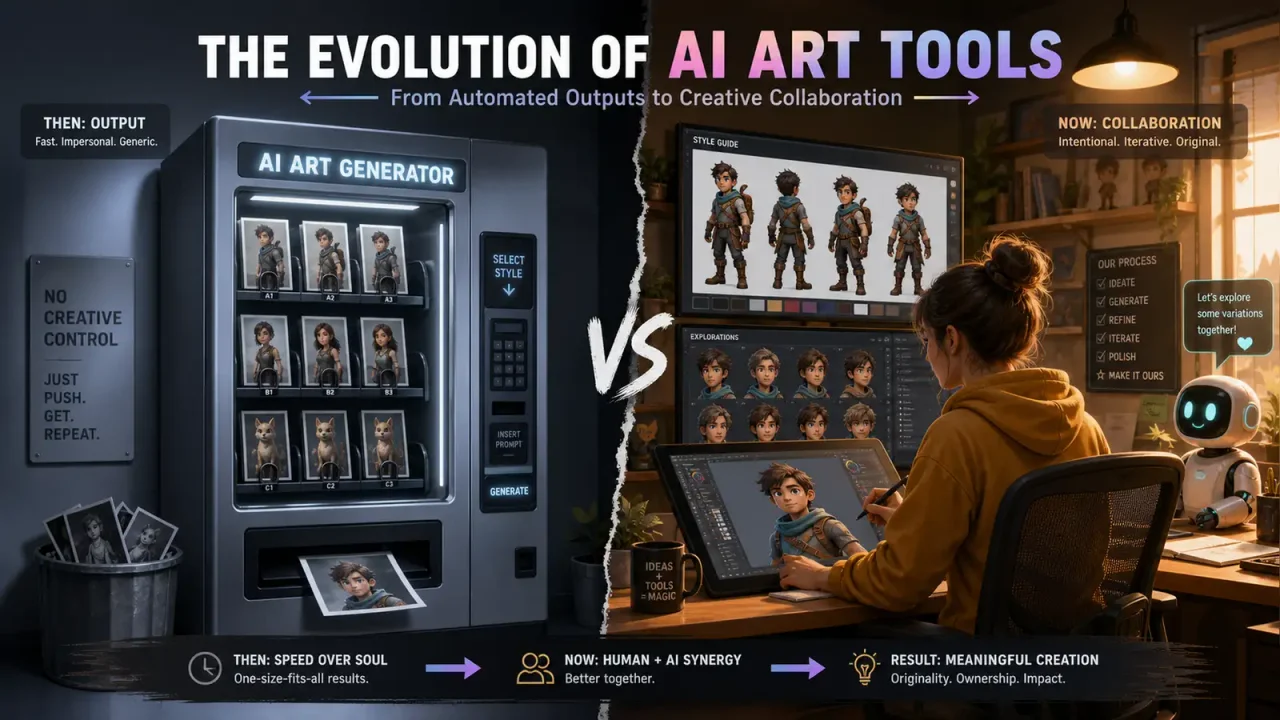
AI art tools are shifting from a “vending machine” model, where each prompt produces an isolated image, toward conversational, stateful workflows that remember a project’s context, keep assets stylistically consistent and edit existing work rather than starting over. Meshy’s 3D Agent, opened as a beta to all users in July 2026, is a clear example: it keeps context across a conversation so creators can brainstorm, generate families of consistent game assets and export them into standard pipelines (80 Level). Firefly’s in-image editing and Runway’s refinement tools follow the same direction. For artists, the practical effect is faster exploration and production of variations, with creative judgement still human.
Vending machine vs creative partner
| One-shot generation | Iterative, stateful workflow | |
|---|---|---|
| Unit of work | A single prompt and output | A project with shared context |
| Changes | Rewrite the prompt and regenerate | Apply directed edits to existing work |
| Consistency | Reconstructed by hand each time | Maintained across a set of assets |
| Integration | Export an image and rebuild elsewhere | Edit in place or export to production formats |
| Best for | Quick ideas and experiments | Projects spanning days or weeks |
Why one-shot prompting breaks down
Real creative work is iterative. A character designer produces turnarounds, expression sheets, outfit variations and props, all of which must match in style, proportion and lighting. When an art director asks for smaller eyes or a sharper jaw, the change needs to carry across every version. In a one-shot tool, each variation is a separate generation; the artist must reconstruct the style description every time and hope for consistency. Image quality is rarely the bottleneck. The workflow is.
Meshy’s 3D Agent
According to 80 Level, Meshy describes its 3D Agent as the first fully conversational, multi-step AI agent built specifically for 3D creation. Instead of treating each prompt as isolated, it maintains context across a conversation, letting creators establish an art direction, brainstorm concepts, generate batches of related game assets and convert selected concepts into textured 3D models within one chat.
| Item | Detail (as reported by 80 Level) |
|---|---|
| Company | Meshy, Sunnyvale, California, founded 2021; CEO Ethan Hu |
| Scale | Company says more than 12 million registered users have generated over 100 million 3D models |
| Funding | $400 million Series B at a $1.5 billion valuation |
| Export formats | GLB, FBX, OBJ, USDZ, BLEND, STL, 3MF, DXF |
| Target pipelines | Blender, Maya, 3ds Max, Unreal Engine, Unity, Godot, Roblox |
| Positioning | Concept exploration, environment ideation, background props and usable starting points, not a replacement for finished game art |
User and funding figures are company-reported. The positioning is notably modest: Meshy pitches the agent for the front end of production, where speed of exploration matters most, rather than for hero assets. For a comparison of 3D generators, see our guide to AI 3D model generation for game design.
The broader shift across tools
Adobe Firefly in Photoshop and Illustrator frames generation as an assist within an existing composition. Generative Fill extends or alters a selected region, so the surrounding image, lighting and colour already provide context. The AI fills a gap rather than starting from nothing.
Runway’s video tools have moved from simple prompt-to-clip generation toward refinement: extending clips, modifying elements within a scene and building on existing footage.
Midjourney has added style references and character-consistency features that anchor new generations in the look of earlier images. These help, though they are less complete than a fully stateful project workflow.
The pattern mirrors how creative software has always evolved. Photoshop did not win because it applied the best single filter; it won with layers, history and non-destructive editing that let people change their minds. AI tools that last in professional use are likely to be the ones that build equivalents of layers and history around generation.
What changes for artists
More exploration in the same time. If generating concept variations takes an hour instead of days, artists can explore more directions or spend more time refining the chosen one. Judgement about what works, and why, remains human.
Lower technical barriers. Earlier tools rewarded elaborate prompt engineering. Conversational interfaces let people with strong visual instincts but little interest in prompt syntax participate more easily.
Pressure on production tasks. The roles most affected are repetitive tasks between creative decisions, such as minor prop variations and early-stage blocking, rather than art direction. Artists who use the tools to multiply their judgement are better placed than those who compete with them on volume.
Rights and disclosure still matter. Copyright protects human contributions, not purely AI-generated output, so documenting the human role is important for commercial work. Our guide to AI art and copyright covers the details.
An example workflow
A small game team designing props for a fantasy tavern might work like this: establish the art direction in conversation with an agent (materials, era, palette and level of wear), generate a batch of concept props, discard most of them and keep the few that fit, ask for directed changes such as “less ornate, more weathered wood” applied to the chosen set, convert the best concepts to 3D models, then import them into the engine for clean-up, optimisation and integration by an artist. The AI accelerates exploration and first drafts; people choose, refine and finish.
Common questions
Will conversational tools replace prompt skills? Partly. Clear communication of visual intent still matters, but syntax tricks matter less.
Are generated 3D assets production-ready? Usually not without work. Expect to check topology, UVs, textures and performance budgets before shipping.
How to evaluate an iterative AI tool
- Does it remember context? Test whether directed edits apply to the existing asset or trigger a fresh generation.
- How consistent is a set? Generate five related assets and check style, proportion and materials.
- Does output fit your pipeline? Check formats, topology, UVs and texture quality for 3D; resolution and layers for 2D.
- What are the licence terms? Confirm commercial use rights and whether uploads are used for training.
- How much clean-up is needed? Time the work from generation to production-ready, not just the generation itself.
Our analysis
The move from one-shot prompts to stateful, conversational tools is the most practically important change in AI creative software, more so than incremental gains in image quality. It aligns AI with how artists actually work: iteratively, in sets and inside existing pipelines. Meshy’s modest positioning of its 3D Agent for concept work and starting points is the realistic framing. Studios and artists should evaluate these tools on context retention, consistency and pipeline fit, keep humans in charge of art direction and final assets, and document the human contribution for rights purposes.