AI Art and Copyright: Who Owns AI Images, Is Training Fair Use, and What the Key Rulings in the US, UK, EU and China Say
Where the law stands on AI-generated art: the U.S. Copyright Office's human-authorship rule, Thaler and Zarya of the Dawn, training-data cases including Andersen, Bartz v. Anthropic and the UK Getty v. Stability AI judgment, EU AI Act copyright duties, the UK and China, and practical steps for artists and clients.
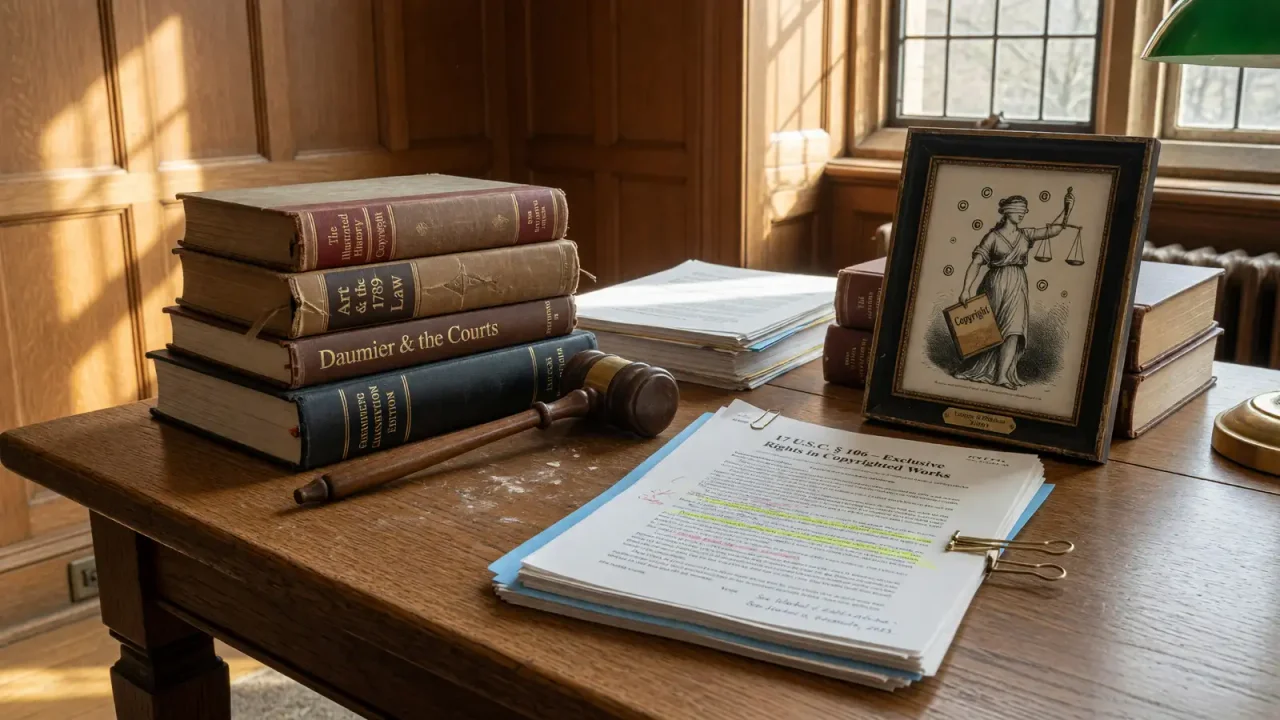
Two separate legal questions surround AI art. The first is who owns AI-generated images. In the United States, the answer is fairly settled: copyright protects human authorship, so purely AI-generated output is not protected, but human contributions such as selection, arrangement and modification can be. The second is whether training AI models on copyrighted works is lawful, and that remains contested. Courts have reached early, fact-specific decisions, such as the UK High Court’s November 2025 ruling largely against Getty Images in its case against Stability AI, but there is no general answer yet. Artists should document their process, disclose AI use when registering works and check each tool’s terms.
Ownership of AI-generated images: the U.S. position
| Source | What it says |
|---|---|
| U.S. Copyright Office registration guidance (March 2023) | Applicants must disclose AI-generated material that is more than de minimis and claim only the human-authored portions (Federal Register) |
| Zarya of the Dawn (2023) | The Office registered the comic’s human-written text and the selection and arrangement, but not the individual Midjourney-generated images (Wikipedia) |
| Copyright Office report, Part 2: Copyrightability (January 29, 2025) | Prompts alone generally do not give enough control over outputs; human-authored inputs, creative selection and arrangement, and modifications of AI output can be protected (copyright.gov/ai) |
| Thaler v. Perlmutter (D.C. Circuit, March 2025) | A work listing an AI system as its sole author cannot be registered, because the Copyright Act requires human authorship |
The practical effect: an image generated from a single prompt is unlikely to be protected. A work in which a person makes substantial creative contributions, such as drawing the underlying composition, combining and arranging multiple outputs, or painting over and modifying generated elements, can be protected to the extent of those human contributions. The Office evaluates applications case by case.
The training-data question
Whether training on copyrighted works without permission is lawful is being litigated separately, and outcomes so far are narrow.
| Case | Jurisdiction | Status and significance |
|---|---|---|
| Andersen v. Stability AI | U.S. (N.D. Cal.) | Artists v. Stability AI, Midjourney, DeviantArt and Runway; key copyright claims allowed to proceed in 2024 |
| Bartz v. Anthropic | U.S. (N.D. Cal.) | In June 2025, the judge found training on lawfully acquired books to be fair use but allowed claims over pirated copies to proceed; Anthropic later agreed to a $1.5 billion settlement (Wikipedia) |
| Getty Images v. Stability AI | UK High Court, judgment November 4, 2025 | Getty abandoned its training and output claims at trial (training took place outside the UK). The court held that the Stable Diffusion model is not an “infringing copy” and dismissed the secondary infringement claim; Getty succeeded only in part on trade mark claims over watermarks, findings the judge called “historic and extremely limited in scope” (judgment) |
| Disney, Universal and Warner Bros. v. Midjourney | U.S. (C.D. Cal.) | Studio suits filed in 2025 over character images; see our case guide |
The U.S. Copyright Office also released a pre-publication version of Part 3 of its AI report, on generative AI training, in May 2025, analysing how fair use applies. These decisions and analyses are fact-specific, and none settles the question for image models generally. Notably, the UK Getty ruling turned on where training happened: claims about training itself must generally be brought where it occurred.
Outside the United States
| Jurisdiction | Approach |
|---|---|
| European Union | The AI Act requires providers of general-purpose AI models to publish a summary of training content and to have a policy to comply with EU copyright law, including respecting text-and-data-mining opt-outs (Article 53). Article 50 adds transparency duties for AI-generated content |
| United Kingdom | The Copyright, Designs and Patents Act 1988 has a provision for “computer-generated works”. The government consulted from December 2024 to February 2025 on AI and copyright, including a possible text-and-data-mining exception with rights reservation, and has since published a report and impact assessment (GOV.UK) |
| China | On November 27, 2023, the Beijing Internet Court recognised copyright in an AI-generated image where the user made substantial creative choices in prompting and parameter selection (Wikipedia) |
| Japan | Copyright law includes a broad exception allowing use of works for data analysis, widely read as permitting much AI training, with limits where use unreasonably harms rights holders |
Labelling and transparency
Separate from ownership, transparency rules are spreading. EU AI Act Article 50 requires providers of generative AI systems to mark synthetic content in a machine-readable way and requires deployers to disclose deepfakes, with obligations applying from August 2026. Platforms such as YouTube and TikTok require labels on realistic AI-generated content. Labelling does not affect copyright, but it affects how AI-assisted work must be presented.
What artists and clients should do
- Document your process. Save sketches, prompt iterations, selections and edits. If you need to show human authorship, the record matters more than the final image.
- Disclose AI use when registering works in the U.S., and claim only the human-authored parts.
- Check each tool’s terms on output ownership, commercial use, indemnities and whether your uploads are used for training. Adobe markets Firefly as trained on licensed and public domain content and offers indemnities to some enterprise customers; other tools have different terms.
- Avoid prompting for living artists’ names or protected characters, which raises legal and reputational risks.
- Address AI in contracts. Clients increasingly specify whether AI may be used and who bears the risk.
Our analysis
The ownership question is more settled than headlines suggest: in the U.S., human creativity is protected and machine output is not, so the more a person shapes a work, the stronger the claim. The training question is far from settled. Early rulings like Bartz and the UK Getty decision are narrow and fact-specific, and the outcomes of the artist and studio cases against image-model companies will matter more. Until then, the safest course for professionals is to keep the human contribution substantial and documented, choose tools with clear licensing terms, and treat AI output as raw material rather than finished, ownable work.