AI 3D Model Generation in 2026: How Text-to-3D Works, Leading Tools and Where It Fits in Game and Product Pipelines
How text-to-3D and image-to-3D generation works, what tools such as Meshy, Tripo, Luma Genie, Tencent Hunyuan3D and Microsoft TRELLIS offer, where generated assets fit in game, product and architecture workflows, their topology and rigging limits, and the disclosure and labour rules to know.
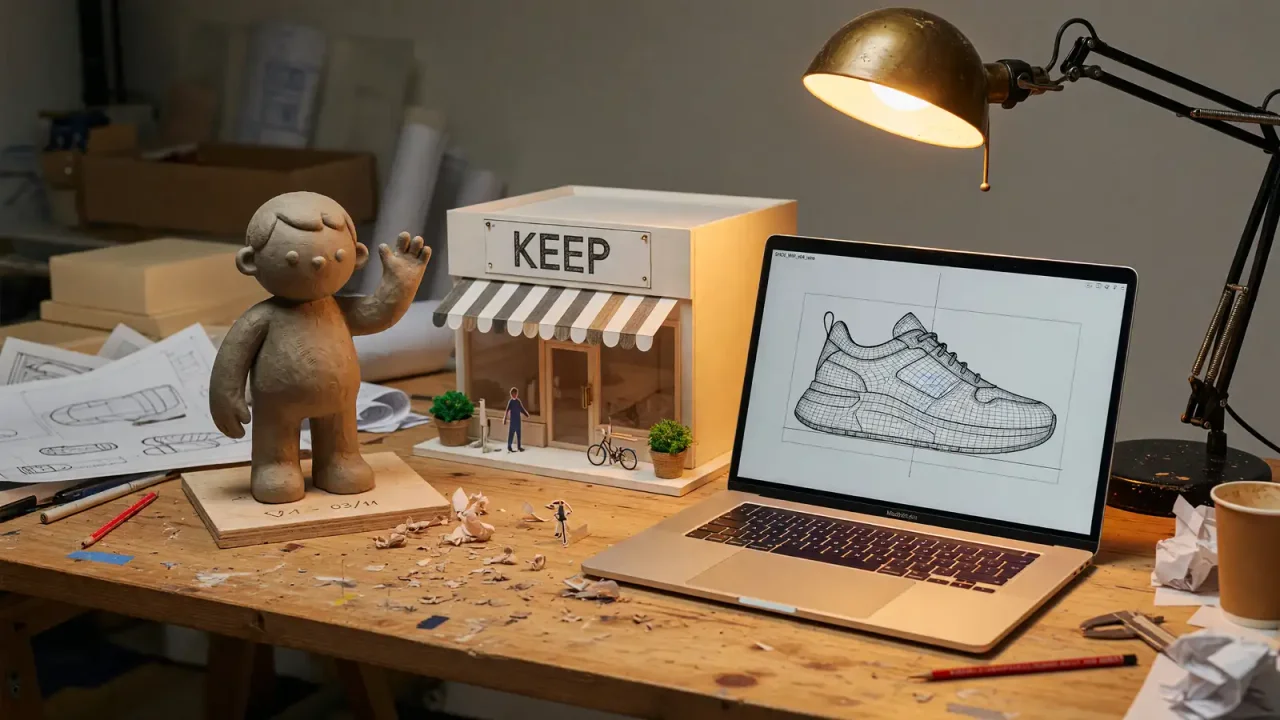
AI tools that generate 3D models from a text prompt or a single image have improved quickly. Early text-to-3D systems in 2022 and 2023 were slow and produced blurry, misshapen objects. Current tools can produce textured meshes in minutes, export them in standard formats and, in some cases, rig characters automatically. They are not replacing 3D artists, but they are changing how studios prototype and how small teams fill out scenes. This guide explains how the technology works, what the main tools offer and where generated assets fit.
Why 3D is harder than 2D
A generated image only has to look right from one viewpoint. A 3D asset needs geometry, textures and materials that hold up from every angle, plus mesh structure that works in a game engine or renderer. For characters, it also needs a skeleton (rig) and topology that deforms cleanly when animated. Each requirement adds a way for generation to fail.
How the technology works
Three research lines underpin most current tools.
Using 2D diffusion to guide 3D. Google’s DreamFusion (2022) showed that a pretrained text-to-image diffusion model could guide the optimisation of a 3D representation from text alone. It was slow, but it proved the idea.
Multi-view generation and reconstruction. Many systems first generate several consistent views of an object and then reconstruct 3D geometry from them, using representations such as neural radiance fields or 3D Gaussian Splatting, which enabled real-time rendering of reconstructed scenes.
Native 3D generative models. Newer models are trained directly on large 3D datasets. Microsoft’s TRELLIS uses a structured latent representation that can be decoded into radiance fields, 3D Gaussians or meshes, with pre-trained models of up to 2 billion parameters trained on 500,000 objects; its authors note that text-conditioned models are less detailed than image-conditioned ones because of data limits. Tencent’s Hunyuan3D 2 separates shape generation from texture painting; version 2.1, released in June 2025, was fully open-sourced with a physically based rendering (PBR) texture model and training code.
NVIDIA’s GET3D (2022) was an influential research model for generating textured meshes, but it is a research project rather than a commercial tool.
The main tools
| Tool | Type | Notable features |
|---|---|---|
| Meshy | Commercial web app and API | Text- and image-to-3D, HD texturing, auto-rigging for humanoid and quadruped characters, export to FBX, GLB, OBJ and USDZ |
| Tripo | Commercial web app and API | Text- and image-to-3D aimed at games and 3D printing |
| Luma Genie | Commercial app | Text-to-3D from Luma AI, known for photo-based 3D capture |
| Rodin (Hyper3D) | Commercial app and API | Image- and text-to-3D focused on production-quality assets |
| Hunyuan3D | Open-source models | Shape and PBR texture generation you can run yourself |
| TRELLIS | Open-source research models | Flexible outputs: meshes, Gaussians, radiance fields |
Meshy lists compatibility with Unity, Unreal Engine, Godot, Blender and Maya, which reflects a general trend: the useful tools are the ones that fit existing pipelines rather than standing alone.
Where generated 3D fits
Game development. The strongest uses are prototyping, greyboxing and blockouts, concept exploration and background props that the player never inspects closely. Small teams can fill scenes faster, while hero characters and key props are still modelled and refined by artists.
Product visualisation and e-commerce. Image-to-3D can turn product photos into models for 360-degree views or augmented reality previews. Accuracy matters here, because a model that misrepresents a product’s shape or proportions can mislead buyers, so outputs need checking against the real item.
Architecture and interiors. Generated furniture and decor can populate visualisations and virtual staging, though the building itself is still designed in CAD and BIM tools where dimensions are exact.
3D printing. Hobbyists use generated models for figurines and props, but printability depends on watertight geometry and wall thickness, which may need repair.
Limits and the human role
Generated assets usually need cleanup before production use:
| Issue | Why it matters | Typical fix |
|---|---|---|
| Messy topology | Dense, irregular meshes are hard to animate and expensive to render | Retopology tools or manual rebuild |
| Inconsistent UVs and baked lighting | Textures may not respond correctly to in-game lighting | Re-texturing with PBR materials |
| Weak fine detail and symmetry | Hands, faces, text and mechanical parts are often wrong | Manual sculpting and modelling |
| Style consistency | Assets from different prompts may not match a game’s art direction | Reference images, style guides, artist passes |
| Rigging quality | Auto-rigging covers standard body types but not every character | Rigger review and adjustment |
The pattern resembles 2D image generation: AI speeds up exploration and routine work, while artists make the aesthetic decisions, ensure consistency and bring assets up to production standards.
How to evaluate a 3D generator
Before adopting a tool, test it on assets that resemble your real needs rather than the vendor’s showcase. Generate the same five to ten objects in each candidate, import them into your engine or renderer, and check polygon counts, UV layouts, texture resolution and how the materials respond to your lighting. If you need characters, test rigging and a basic animation. Time the full path from prompt to a usable asset, including cleanup, because a tool that generates quickly but needs hours of repair may save less than it appears. Finally, read the licence: some open models restrict commercial use or use in certain regions, and commercial services set their own terms on ownership of outputs.
Research behind the tools
- 3D Gaussian Splatting (Kerbl et al., SIGGRAPH 2023): enabled real-time rendering of scenes reconstructed from photos and became a foundation for many capture and generation tools (arXiv:2308.04079).
- DreamFusion (Poole et al., 2022): showed that 2D diffusion models can guide 3D generation from text (arXiv:2209.14988).
Industry rules and labor issues
- Steam: since January 2024, Valve has required developers to disclose AI-generated content in their games, covering both pre-generated and live-generated content (Steam announcement).
- Voice and performance: SAG-AFTRA’s video game strike, which began in July 2024, centered largely on protections against AI replicas of performers. In 2025, members ratified a new agreement with consent and disclosure requirements.
Our analysis
Generated 3D has crossed from research demos into practical tools, with open models such as Hunyuan3D and TRELLIS alongside commercial services like Meshy and Tripo. It is most valuable for prototyping, blockouts, background props and concept work, and it pays off when paired with retopology, re-texturing and artist review. Studios should track which assets were generated so they can disclose accurately on storefronts such as Steam, check each tool’s licence and commercial terms, and treat hero assets as work for artists.