Governed AI Coworkers: What Atomicwork and NiCE Launched in June 2026 and How to Evaluate AI Workforce Platforms
Atomicwork and NiCE both launched platforms on June 9, 2026 that manage AI agents like staff, with job roles, budgets, scoped permissions and audit trails. What each announced, what is vendor-claimed, and the questions IT leaders should ask before deploying AI coworkers.
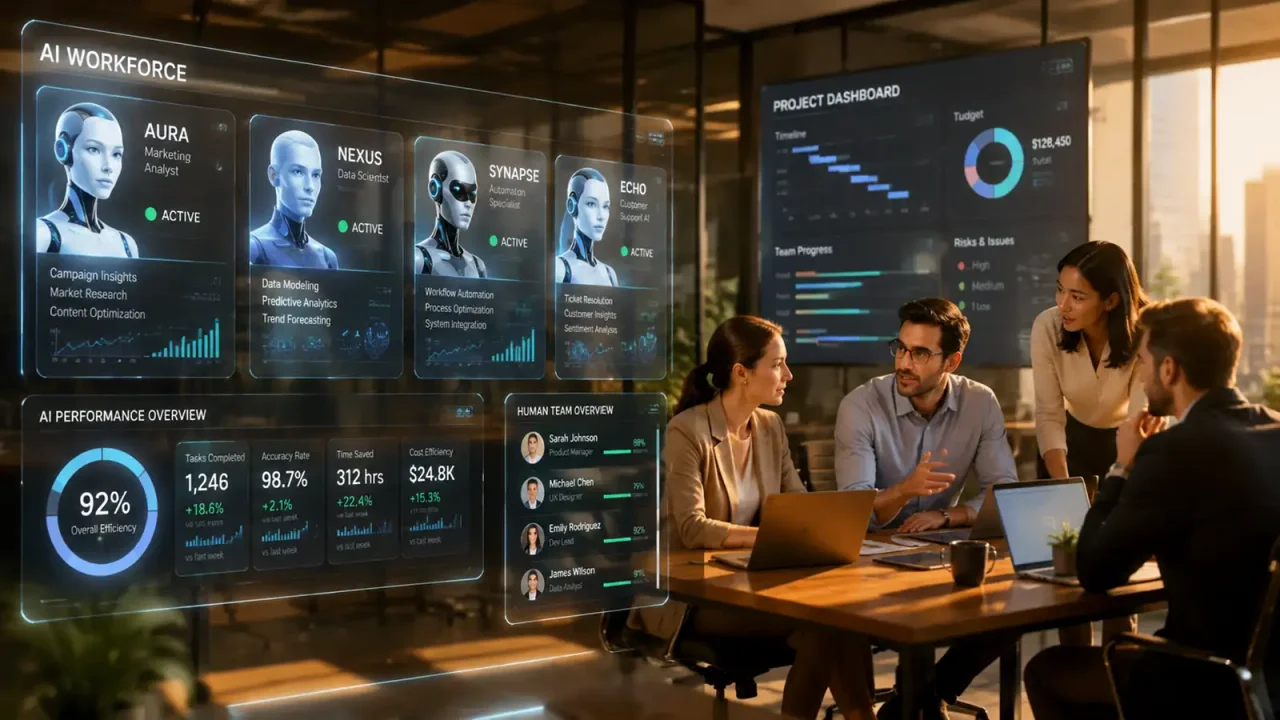
On June 9, 2026, two enterprise software companies launched products built on the same idea: AI agents should be managed like members of staff, with defined roles, budgets, scoped permissions and an audit trail, rather than bolted onto workflows as chatbots. Atomicwork made its AI Workforce Platform generally available for IT, HR, Finance and Workplace teams, and NiCE introduced its Workforce Empowerment Suite for contact centres that mix human and AI agents. Both launches are vendor announcements and their performance claims are unverified, but the governance model they describe, bounded authority plus logging plus human escalation, is a sensible template for any organisation putting AI agents into production.
The two launches at a glance
| Atomicwork AI Workforce Platform | NiCE Workforce Empowerment Suite | |
|---|---|---|
| Announced | June 9, 2026 (general availability) | June 9, 2026, at NiCE World 2026 |
| Domain | Enterprise service management: IT, HR, Finance, Legal, Workplace | Contact centre and customer experience |
| Core idea | ”AI Coworkers” with job roles, skills, budgets and scoped permissions | One operating model for human employees and AI agents |
| Governance | Workforce control plane: spend limits, scoped access, audit trail per action | Shared rules, goals and quality standards for humans and AI |
| Deployment | Layers on existing ITSM/ESM such as ServiceNow or Jira Service Management | Part of NiCE’s CXone platform |
| Notable claims | Live “in days, not quarters”; a customer (Zuora) reports 50% fewer tickets after two years | GenAI quality evaluation of up to 100% of interactions; SOC 2 Type II, ISO 27001, PCI DSS, FedRAMP Moderate |
Sources: Atomicwork press release via AI Journal; NiCE press release via Yahoo Finance.
Atomicwork: AI coworkers for service management
According to the company, each AI Coworker operates with live enterprise context and handles service work such as provisioning access, responding to incidents, onboarding employees and troubleshooting hardware, without requiring human involvement at every step. A general-purpose coworker called Atom handles frontline employee queries across Microsoft Teams, Slack, MCP clients, email, browser and portal, while purpose-built coworkers cover specific departments. They delegate to one another based on defined scope and hand off to a human with context attached when required.
Atomicwork positions this against traditional ITSM tools, which it says are built to track tickets rather than resolve them. CEO Vijay Rayapati described the platform as replacing “the workflow model underneath IT,” adding: “It’s not a better candle. It’s the lightbulb. IT runs the AI Workforce the same way HR runs human teams.”
The platform’s governance layer, which Atomicwork calls a workforce control plane, gives IT visibility into every AI Coworker, including spend limits, scoped access and an audit trail for every action. The company says teams on ServiceNow or Jira Service Management can layer it on top of their existing setup without replacing those systems.
The one outcome figure in the announcement comes from a customer quote. Zuora’s CIO, Karthik Chakkarapani, said two years on the platform had produced “fifty percent fewer tickets and a fraction of the manual coordination work.” That is a single customer’s self-reported result in a vendor press release, not an independent measurement.
NiCE: one model for human and AI agents
NiCE approaches the same problem from customer service. Its suite unifies workforce management, quality, performance, compliance and AI operations on one platform, so that “the same rules, goals, and quality bar apply whether an interaction is handled by a person or an AI agent.” It includes AI forecasting and scheduling, a Copilot for Workforce Managers and generative AI quality workflows that the company says can evaluate up to 100% of interactions.
“Every enterprise is now running a hybrid workforce of people and AI agents,” said Jeff Comstock, NiCE’s President of CX Product & Technology. Analyst Sheila McGee-Smith of McGee-Smith Analytics, quoted in the release, called it “one of the most consequential shifts in workforce operations in a generation” and framed the question every customer service operation will face: “how do you govern, coach, and scale a workforce that is half human and half AI?”
NiCE lists SOC 2 Type II, ISO 27001, PCI DSS and FedRAMP Moderate authorization among the standards the suite is built on. FedRAMP Moderate matters for US public-sector buyers, and the combination signals that vendors are pitching AI agent management to regulated industries, not only to early adopters.
Why the “coworker” framing matters
From assistance to ownership
Most enterprise AI tools so far assist people who keep ownership of a process: a search tool helps an analyst find troubleshooting steps, but the analyst decides and is accountable. The coworker model gives an agent a whole process, such as receiving a request, diagnosing it, acting and documenting the result, and escalating only at defined boundaries. That raises the stakes for how those boundaries are designed.
Governance built into the architecture
The persistent obstacle to deploying agents is accountability: who answers when an agent does something wrong? Both vendors respond by treating governance as part of the product: explicit limits on what an agent can access, spend and do on its own, plus logs of every action. An audit trail serves compliance, performance measurement and incident investigation at once. It does not remove the need for a named human owner, but it makes oversight possible.
Production, not pilots
TechCrunch’s VivaTech 2026 preview, published as part of an event partnership, described the industry as “confronting the realities of moving AI from experimentation to production at scale,” with governance, compliance, security and integration now the hard problems. Agent management platforms are a direct response to that shift. For the organisational side of scaling, see our piece on lessons from cloud adoption.
Questions to ask before deploying AI coworkers
| Question | Why it matters |
|---|---|
| Does it integrate with our existing ITSM, CRM or contact-centre stack? | Replacing core systems adds cost and delay; layering on top lowers risk |
| How granular are permissions and budgets per agent role? | Coarse controls cannot reflect real organisational boundaries |
| Is the audit trail complete, tamper-evident and exportable? | Regulated industries need evidence that satisfies auditors |
| What triggers escalation to a human, and can we tune it by risk? | Escalation design determines both safety and actual workload reduction |
| Can we see cost per agent and per task? | Usage-based AI costs scale with volume and need budgeting like contractor spend |
| Can actions be reversed, and who is accountable for each agent? | Bounded, reversible actions with a named owner limit the damage from errors |
| What evidence backs the vendor’s outcome claims? | Press-release figures are self-reported; ask for references and run your own baseline |
A practical approach is to start with high-volume, low-risk work such as password resets, access requests for standard tools or onboarding checklists; measure resolution time, accuracy and escalation rates against a baseline; and widen agent permissions only once the logs show reliable behaviour. Shadow AI risk also falls when employees have a sanctioned, governed option, a point we cover in our shadow AI governance guide. For the regulatory side, including the EU AI Act timeline, see our enterprise AI governance and compliance overview.
Our analysis
The Atomicwork and NiCE launches are marketing as much as product news, and their headline results are vendor or customer claims that no independent study has yet tested. What is worth taking from them is the management model: treat AI agents as accountable participants in a process, with written job scope, spending limits, least-privilege access, complete logs and a clear path to a human. That model is vendor-neutral and applies whether an organisation buys one of these platforms, uses agent features from its existing suppliers or builds its own. The organisations likely to get value from AI agents are those that design these controls first and expand autonomy only as evidence accumulates, rather than those that deploy the most agents fastest.