Shadow AI Governance: What BlackFog's 2,000-Worker Survey Found About Unapproved AI Tools and How to Respond
BlackFog's shadow AI research found 86% of employees use AI weekly and 49% use tools their employer has not approved, with many sharing sensitive data. What drives shadow AI, why bans backfire, and a practical governance framework using NIST AI RMF, approved tools, DLP and fast approval paths.
Related coverage: Shadow AI Agents: Surveys Find About 3 in 10 Are Unsanctioned — How IT Teams Can Respond
Shadow AI, meaning employees’ use of AI tools their employer has not approved, is widespread and driven mainly by unmet demand rather than bad intent. In research by security firm BlackFog based on a survey of 2,000 employees, 86% said they use AI tools at least weekly for work, and 49% said they use AI tools not sanctioned by their employer (BlackFog). Many share sensitive data with those tools. Bans tend to push usage out of sight; the more effective response is to provide a good approved option, set clear data rules, monitor for sensitive uploads and make approving new tools fast.
What the survey found
All figures are from BlackFog’s published research. BlackFog sells data-exfiltration prevention software, so treat these as vendor-reported findings.
| Finding | Share of respondents |
|---|---|
| Use AI tools at least weekly for work | 86% |
| Use AI tools not sanctioned by their employer | 49% |
| Use free versions of company-approved AI tools | 34% |
| Of those using unapproved tools, rely on free versions | 58% |
| Think it is acceptable to use AI without IT oversight if no approved option exists | 63% |
| Agree unsanctioned AI is worth the security risk to work faster or meet deadlines | 60% |
| Have connected AI tools to other work systems without IT approval | 51% |
| Have shared research or data sets with unsanctioned tools | 33% |
| Have shared employee data such as names, payroll or performance information | 27% |
| Have shared financial statements or sales data | 23% |
Two findings stand out. First, seniority increases risk tolerance: 69% of respondents at president or C-level and 66% at director or senior VP level said speed trumps privacy or security, compared with 37% in administrative roles. Shadow AI is not just a junior-staff problem. Second, 63% think unsupervised use is fine when no approved option exists, which points directly at the fix: provide one.
Why employees go around IT
The approved tool is missing or weaker. If the company offers nothing, or a restricted tool that cannot handle common tasks, people use consumer tools that can.
Approval is slow. Formal procurement can take weeks or months; a free web tool takes seconds.
Habit. People who use AI at home continue at work, often adding the work tool to their personal ones rather than replacing them.
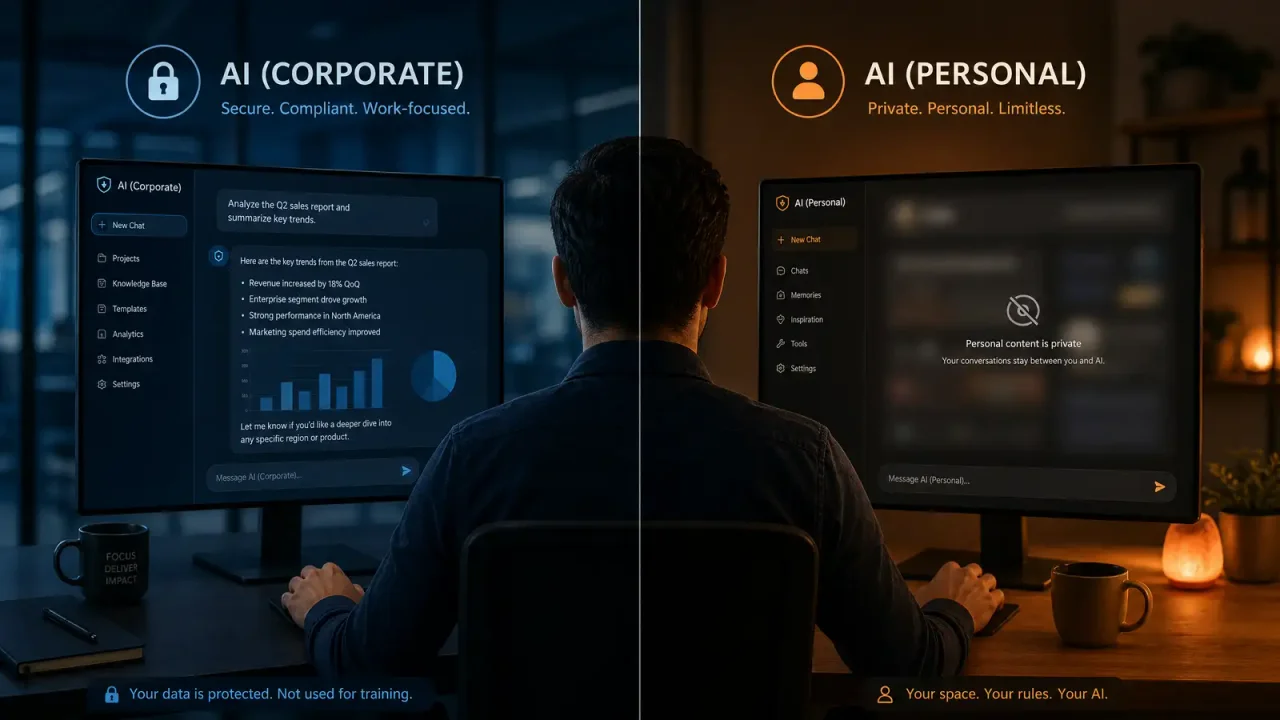
Perceived privacy. Some employees take sensitive or unfinished questions to personal tools because they feel less monitored, even though consumer tiers often offer weaker data protections.
Unclear rules. Many workers do not know whether a policy exists or what data it covers.
Why it matters
Free consumer tiers may retain inputs, use them to improve models by default and lack audit trails, single sign-on and retention controls. When someone pastes a contract, customer list or source code into such a tool, the company loses control of that data. A widely reported example came in 2023, when Samsung restricted employee use of generative AI tools after staff uploaded sensitive internal code (TechCrunch). Unapproved integrations, which half of BlackFog’s respondents admitted to, add another risk: AI tools connected to email, file storage or business systems can access far more data than a single pasted prompt.
The pattern is not new. Microsoft and LinkedIn’s 2024 Work Trend Index found that 75% of knowledge workers used generative AI at work and 78% of those users brought their own AI tools (Microsoft WorkLab).
A governance framework that works
| Step | What to do | Why |
|---|---|---|
| 1. Inventory | Find out which AI tools are in use, through surveys, network logs and expense reports | You cannot govern what you cannot see |
| 2. Provide | Offer at least one capable, sanctioned assistant with enterprise data protections | Removes the main reason for shadow use |
| 3. Classify | Publish plain-language rules on which data classes may never go into any AI tool | Gives employees clear limits |
| 4. Monitor | Use data loss prevention and browser controls to detect sensitive uploads | Catches mistakes and risky behaviour |
| 5. Approve fast | Create a lightweight request path with published evaluation criteria | Channels demand into the open |
| 6. Train | Explain the data differences between consumer and enterprise tiers, not just how to use tools | Most shadow use comes from not knowing the risk |
| 7. Review | Revisit the tool list and policy regularly as products and risks change | AI tools change monthly |
The NIST AI Risk Management Framework provides a voluntary structure for this work, including inventories of AI systems, clear accountability roles and ongoing monitoring.
Evaluation criteria to publish
When employees know what gets approved, they are more likely to ask first. Typical criteria include whether the vendor trains on customer data, data retention and deletion controls, data residency, single sign-on and access controls, audit logging, security certifications and how the tool connects to other systems.
Common questions
Should we block consumer AI sites at the network level? Blocking can be part of the answer for high-risk teams, but on its own it tends to push usage to personal phones and home networks. Pair any blocking with an approved alternative.
Is a paid enterprise licence enough? It solves data protection for that tool, but not for others people still use. Inventory, policy and training are still needed.
What about AI features inside existing software? Many SaaS products now add AI features by default. Include them in the inventory and check each vendor’s data terms, since they may process company data with third-party models.
Our analysis: bans backfire
When companies ban AI without offering an approved alternative, usage tends to move to personal devices and accounts, where the security team has no visibility at all. BlackFog’s finding that 63% consider unsupervised use acceptable when no approved option exists supports that view. The more effective pattern is to provide a sanctioned tool with enterprise data protections, publish a short policy on which data must never go into any AI tool, use data loss prevention to detect sensitive uploads and create a quick approval path for new tools. Leaders should also model the behaviour: the survey suggests senior staff are the most willing to trade security for speed. Shadow AI is largely a sign of unmet demand, and governance works best when it channels that demand rather than trying to suppress it.