AI Art Authentication in 2026: How Provenance Tracking Is Changing Who Gets Credit
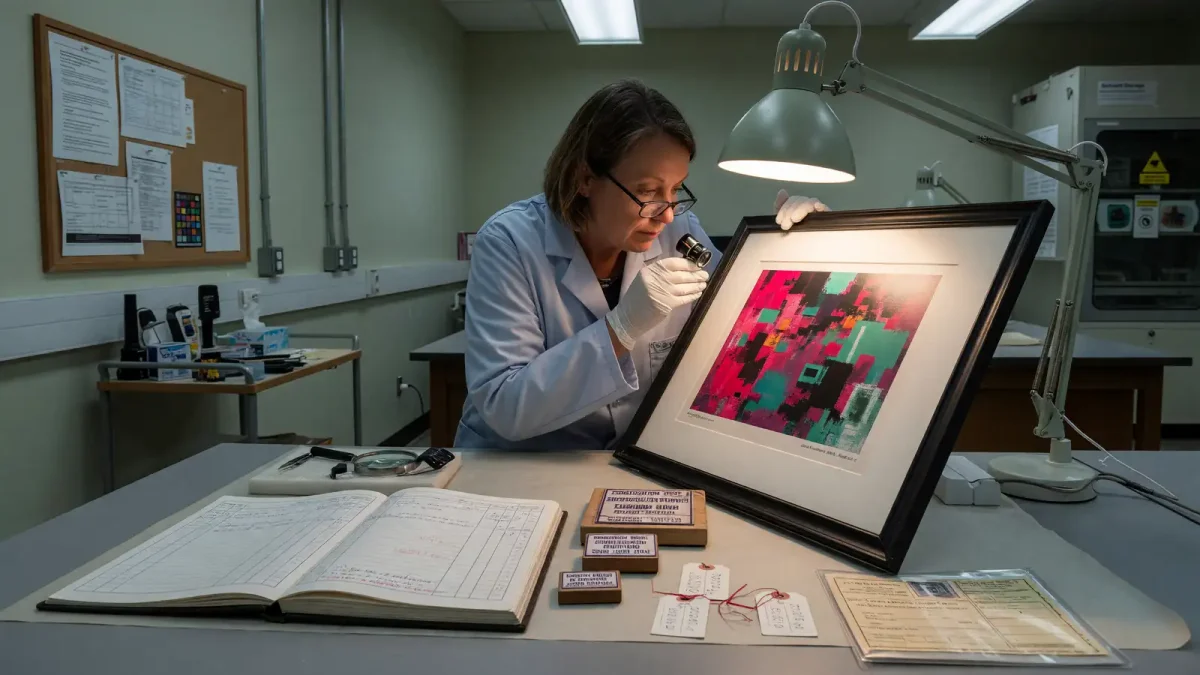
A painting shows up at a gallery. The artist says it is handmade. The curator believes them. The buyer pays $4,000. Three months later, someone runs it through an detection tool and finds it was generated by an AI model. The gallery issues a refund. The artist disappears. The buyer feels cheated. The real artist whose work was likely in the training data feels invisible.
This is not a hypothetical scenario. It is happening with increasing frequency in 2026, and it is pushing the art world toward something it has never needed before: reliable authentication for digital and AI-assisted work.
The problem authentication is trying to solve
The core issue is not that AI art exists. AI-generated images are a legitimate medium, and many artists use them creatively. The problem is attribution. When an image enters the world without clear provenance, no one knows whether it was made by a human, an AI, or a human using AI as a tool. This ambiguity creates real harm.
Human artists lose commissions when clients cannot tell the difference. Collectors overpay for work they believe is handcrafted. Platforms struggle to enforce policies that distinguish AI-generated content from human-made work. And the artists whose work was used to train AI models have no visibility into how their styles are being replicated.
Provenance tracking addresses this by creating a verifiable record of how an image was created, who created it, and what tools were used. Think of it as a birth certificate for digital art.
What authentication tools exist in 2026
Watermarking and fingerprinting
Google’s SynthID remains the most widely deployed invisible watermarking system. It embeds a signal into AI-generated images that survives cropping, compression, and format conversion. The watermark is invisible to the human eye but detectable by tools that know what to look for.
Adobe’s Content Credentials, built into Firefly and Photoshop, attach metadata to images showing the tools used in creation. When an image is generated with Firefly, the metadata includes that information. When it is edited in Photoshop, each edit is logged. This creates a chain of custody that travels with the file.
The EU’s AI labeling rules, which took effect in early 2026, require platforms to标记 AI-generated content. SynthID and Content Credentials are the two systems most platforms are using to comply. The regulation does not mandate a specific tool, but it requires that AI-generated images be identifiable.
Detection tools
On the flip side, detection tools have improved substantially. Hive Moderation, Illuminarty, and Nightshade’s detection suite can identify AI-generated images with accuracy rates above 95% in controlled tests. These tools analyze patterns in pixel data, frequency domains, and neural network artifacts that are invisible to human eyes.
The accuracy varies by model. Images from older models like Stable Diffusion 1.5 are easier to detect than images from the latest generation. Images that have been heavily edited, filtered, or compressed are harder to detect. But the general trend is clear: detection is getting better faster than generation is getting harder to detect.
Blockchain provenance
Some platforms are experimenting with blockchain-based provenance records. Each image gets a hash stored on a ledger that records when it was created, by whom, and with what tools. The advantage is immutability. The disadvantage is that blockchain records can only verify what was uploaded, not whether the upload was truthful. If someone generates an image with AI and uploads it claiming it is handmade, the blockchain faithfully records the lie.
This is where the authentication ecosystem gets complicated. No single tool solves the problem alone.
What is actually working
The most effective authentication in 2026 combines multiple approaches. A platform like Artstation or Behance might require Content Credentials metadata on uploaded images, run detection tools in the background, and maintain a database of known AI-generated styles. No single layer is foolproof, but together they create enough friction to deter casual misattribution.
Galleries and auction houses are taking a different approach. They are requiring artists to submit process documentation, sketches, and progressive work images alongside finished pieces. This is low-tech but effective. An artist who can show a pencil sketch, a digital underpainting, and a series of progressive screenshots has strong evidence of human creation. An artist who can only show a finished image has questions to answer.
The freelance market is adapting too. Platforms like Fiverr and Upwork now offer optional AI-disclosure badges. Sellers who certify their work as human-made and submit to verification get a badge. Buyers can filter by badge status. The system relies on honesty, but the verification process adds a real cost to lying.
Where it falls short
The biggest gap is style replication. An AI can generate an image that looks like a specific artist’s style without copying any single work. Current authentication tools cannot detect this. The image does not match any known AI-generated fingerprint because it was generated with a custom model or a fine-tuned checkpoint. The style is recognizable, but the technical signature is clean.
This problem is particularly acute in commercial art. A company might commission an AI to generate illustrations “in the style of” a popular artist, paying a fraction of what the real artist would charge. The resulting images pass current detection tools because they were generated with a model that has been fine-tuned to avoid known fingerprints. The artist whose style is being replicated has no practical way to prove it, and no legal recourse under current copyright law.
Several startups are attempting to solve this with style-matching databases. They catalog the visual signatures of known artists and compare new images against the database. The technology is promising but controversial. Defining an artist’s “style” in technical terms is subjective, and false positives could damage innocent creators.
This is where the legal system is still catching up. Copyright law protects specific works, not styles. An AI that generates images “in the style of” a living artist is not technically infringing, even if the artist feels violated. Several bills in Congress aim to address this, but nothing has passed yet. The EU’s AI Act includes provisions for training data transparency, but enforcement mechanisms are still being developed.
Another gap is offline authentication. Most tools require uploading an image to a server for analysis. There is no reliable way to authenticate an image by looking at it on a gallery wall or in a printed catalog. Physical art has centuries of provenance traditions. Digital art is still building them.
Why this matters beyond galleries
Authentication is not just an art market problem. Social media platforms need it to enforce AI-disclosure policies. News organizations need it to verify that photographs are real. Courts need it to assess the authenticity of digital evidence. Insurance companies need it to value digital artworks correctly. Academic institutions need it to verify that student submissions are original work. The applications are everywhere once you start looking.
The implications extend to everyday life. When you see an image online, you currently have no reliable way to know whether it was made by a person, an AI, or a person using AI tools. Authentication infrastructure changes that. It does not make every image verifiable overnight, but it builds the foundation for a world where provenance is default rather than optional.
The economic implications are significant too. The global AI-generated content market is projected to reach $12 billion by 2028. As the market grows, the need for reliable provenance tracking becomes a business requirement, not a nice-to-have. Galleries, stock photo platforms, and social media companies all need ways to categorize and value content based on how it was made.
What artists should do right now
If you are a digital artist working in 2026, here is what matters for protecting your work and your reputation.
Enable Content Credentials in your tools. Adobe, Canva, and most major creative software now support it. It takes one click to turn on and creates a permanent record of your creative process. This is the single most impactful thing you can do.
Document your process. Save intermediate files, screenshots of work in progress, and layer files. This evidence is valuable if your work is ever questioned. It is also valuable for clients who want to understand your creative process.
Use detection tools on your own work. Upload your finished pieces to Hive or Illuminarty to establish a baseline. If someone else claims your work is AI-generated, you have evidence that it was not. If someone else’s work looks suspiciously similar to yours, you have a comparison point.
Register your copyright. This costs $65 per work through the U.S. Copyright Office and creates a legal record that can be used in infringement cases. It does not prevent AI training, but it gives you standing to sue if your work is used without permission. For artists selling significant pieces, this is a worthwhile investment.
Consider joining a collective or guild that advocates for artist rights. Organizations like the Artists Rights Society and the Graphic Artists Guild are actively lobbying for stronger protections against unauthorized AI training. Collective action has historically been more effective than individual effort in changing industry norms.
Stay informed about the tools. The authentication landscape is changing fast. What does not work today might work tomorrow. Follow developments from Adobe, Google, and the open-source community. The more you understand the tools, the better you can protect your work and advocate for yourself.
The bigger picture
AI art authentication is not about gatekeeping or deciding which art is “real.” It is about building a system where provenance is transparent and attribution is verifiable. In a world where anyone can generate a convincing image in seconds, knowing where an image came from becomes as important as the image itself.
The tools are imperfect. The legal framework is incomplete. The cultural norms are still forming. But the direction is clear: provenance will become a default expectation for digital images, not an optional feature. Artists who get ahead of this now will be better positioned when the norms solidify.
The gallery scenario I described at the beginning will not disappear. But in a year, the curator will have better tools to catch it before the sale, the buyer will have more information to make a decision, and the real artist will have a way to prove their work is theirs.