LBB published Pablo Díaz on September 28 in its AI Spy series. He is an editor at SOMOS5 AUDIOVISUAL. The interview is about productions made mostly with AI, and about how he picks tools. He does not pick them by launch week.
A new model appears practically every week, he said. That does not mean it helps the work. He tests with exercises and scores control, consistency, movement, speed, cost, and commercial-use terms. Knowledge goes stale fast. He stays self-taught on purpose.
We already had a week where Level-5 pulled trailers and Higgsfield paid contest credits. That was distribution and backlash. This is a shop talking about a bible. If you make pictures, those are different jobs.
He is an editor talking to an ads-and-film trade site, not a model lab. Steal the test list. Do not steal a SOMOS5 logo.
Logistics shrink. Continuity does not
Díaz’s advantage list is the producer list. From a computer you can make locations, characters, and situations that used to mean travel, a crew, and a budget. You can try versions you would never greenlight on a stage. The distance between an idea and a still gets short.
The drawback list is the editor list. Control. Consistency. Human performance. Models leave artefacts. They change a face without being asked. They miss a physical relationship you could have blocked in thirty seconds with two actors and a mark on the floor. He is blunt: it is still harder to specify a precise action or position than to direct it on set.
That is the whole craft argument, and it is not a vibe. Long dialogue, complex physical action, several people interacting, continuity across shots, a product that must look like the SKU: he says traditional methods are still faster and more controllable. Sometimes you put the object on a table and rotate it 45 degrees. You do not write a paragraph to a model about the rotation.
If your “AI film” is a 12-second product loop, his advantage list applies. If your “AI film” is two people arguing in a kitchen for three minutes, his drawback list is the budget. Do not use a roundup to erase that split.
He also will not give you the humanist climax on demand. Cinema, for him, is leaving different from how you entered. Whether AI can do that, he will not police in other people’s nervous systems. That is the one soft paragraph in a practical interview. Leave it as a shrug. The rest of the piece is a workflow.
Magnific and Higgsfield are docks, not religions
His current go-to tools are Magnific and Higgsfield. He uses them as central platforms to test models and to combine image generation, video generation, and enhancement. The specific model changes with the project.
Read that twice if you work in a place that just standardized on one API. He did not say “we shoot in Runway now.” He said the dock is where comparison happens. We already wrote Runway and Pika as video SKUs. Díaz’s sentence is that the SKU is downstream of a test.
The advances he actually cares about lately: better fidelity to references, character consistency, camera-move control, image-to-video, and holding an action longer. That is a continuity shopping list. It is not “photorealism” as a brand.
FindArticles’ 2026 generator roundup is the other genre, dated in search this week. Magic Hour’s Creator plan at $19 a month, or $12 if you pay annually, Pro at $39, Business at $99. Runway for people who need generative video inside a broader production tool. Credits, concurrent jobs, export resolution, and commercial rights decide whether a cheap month is cheap. Use that page as a price list. Do not use it as SOMOS5’s method. Díaz’s method is exercises, not a plan tier.
If your producer asks which model won September, the honest answer from this interview is none of them. The honest answer is which dock let you compare commercial terms before you put a client’s face in the output.
Higgsfield here is a workbench. Higgsfield in the Adathon story was $50,000 in credits for a joke about nobody wanting AI. Same company name. Different receipt. Do not cite the contest as Díaz’s pipeline.
The visual bible is the actual deliverable
SOMOS5 still starts with a brief or a script. Then shot breakdown, characters, locations, wardrobe, art direction, props, aesthetic. The change is that those things get locked as digital assets instead of found or built.
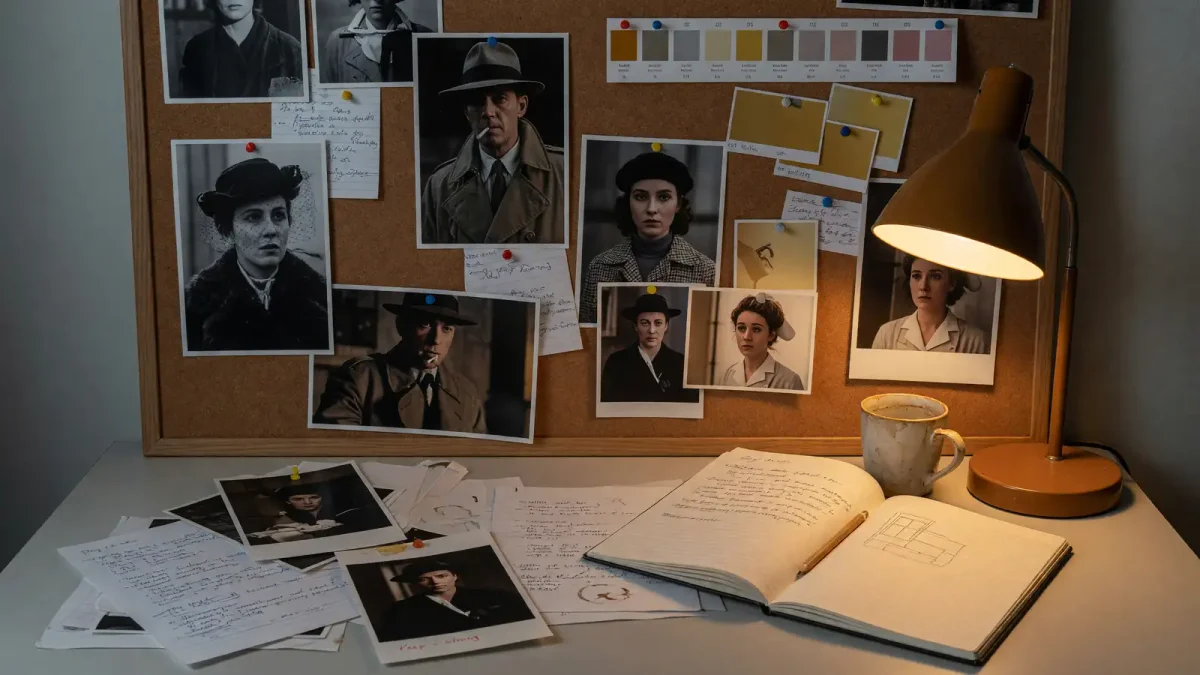
He says an AI production needs a visual bible more, not less. Clear references for characters, locations, proportions, materials, palette, lighting, and camera language. The more coherent the packet you give the model, the better your odds on continuity.
That sentence should end a lot of Discord threads about “the model is inconsistent.” Inconsistency is often an empty packet. We already wrote character-consistency methods. Díaz is saying the method is pre-production, not a slider.
A bible is also a legal object. He puts legal supervision on the crew list for a reason. Commercial-use terms are one of his six test factors. If the model’s terms cannot survive a client’s brand book, the still is not a still. It is a problem for later.
Do not confuse a Pinterest board with a bible. A board is taste. A bible is constraints: this nose, this coat length, this 35mm language, this wall color, this time of day. If you cannot fail a frame against the bible, you do not have one.
Lock assets before you generate the sequence. If you generate the sequence first, you will reverse-engineer a bible from accidents and call it a style. Accidents do not survive shot four.
A prompt is not a department
Díaz does not think the job is hiring someone who can write prompts. A prompt is small and necessary. What matters is image-making, narrative, continuity, and knowing what each model cannot do.
On a small generative production he sketches a crew: director or creative lead; an AI artist for image-making and visual development; someone on animation or video generation; post-production; a producer. Sound, color, VFX, and legal as the project needs them.
That is more people than a weekend Midjourney binge and fewer than a commercial stage. If your studio replaced the DP with a Slack bot, you did not follow this interview. You followed a layoff deck.
The AI artist in his list is not “the prompt person.” Visual development is a department that already existed. The new part is that the department’s output has to survive a generator that will cheerfully ignore the nose.
Self-taught, in his telling, is not a flex. It is maintenance. The stack expires. The bible should not. Train people on how to test, not on a model name that will be embarrassing in November.
If you are staffing, hire for the six factors he scores. Control and commercial terms do not show up in a showreel of pretty stills. Ask to see a failed test and the note that killed the model.
Emotions are still a person, on his account
He will not grant that a generated sad eye is a performance. An actor plays what a character wants, what they hide, and how they stand in relation to someone else. That chain of decisions, he says, you cannot get from artificial generation.
You can argue with that as theory. You cannot argue with it as his production constraint. If the scene lives or dies on a look between two people, he is telling you to put people in a room. If the scene lives or dies on a city that does not exist, he is telling you to generate the city and stop asking it to act.
Product work sits on the same split. A bottle that must match the label is often a table and a 45-degree turn. A bottle in a fantasy desert is a generator plus a bible that includes the label as an asset. Mix those jobs and you will spend Thursday explaining the cap.
Camera language belongs in the bible because generators now sell camera moves. He listed camera-movement control as a real recent gain. A gain is not automatic taste. If every shot dollies, you do not have language. You have a demo.
Speed and cost, the other two test factors, are how you keep the dock honest. A model that is pretty and slow and expensive and unclear on training data is not a win because a timeline looked wet. Díaz’s exercises exist so the pretty week does not become the pipeline.
What to steal if you are not SOMOS5
Write the six factors on the wall: control, consistency, movement, speed, cost, commercial terms. Run a new model through a fixed exercise, not through a vibes prompt. Keep the exercise week to week or you are not testing.
Build the bible before the sequence. Characters, locations, palette, lens. Fail frames against it.
Use a dock that can swap models without swapping your file naming. Díaz’s Magnific/Higgsfield line is “platform,” not “forever vendor.”
Do not chase the weekly release. He said it. The roundup will still chase it, and it will still print $19. The $19 is real money. It is not a method.
If the scene needs a performance, budget a performer. If the scene needs a place you cannot rent, budget generation and a person whose job is continuity. If you only budget the subscription, you budget the artefact.
Image-to-video and longer actions made his recent-gains list for a reason. Those are the shots where a bible dies: a walk that changes coat color, a head turn that changes the nose. If your exercise does not include a five-second hold on a locked character, you are testing stills and calling it film.
Commercial-use terms sit next to cost because a cheap generation with the wrong license is an expensive takedown. Díaz scores both. A producer who only scores cost will learn this from a client’s lawyer.
LBB’s piece is an interview, not a benchmark. There are no latency charts. There is a shop describing how it refuses to be a changelog. That is the news this week for people who already know what Runway costs.