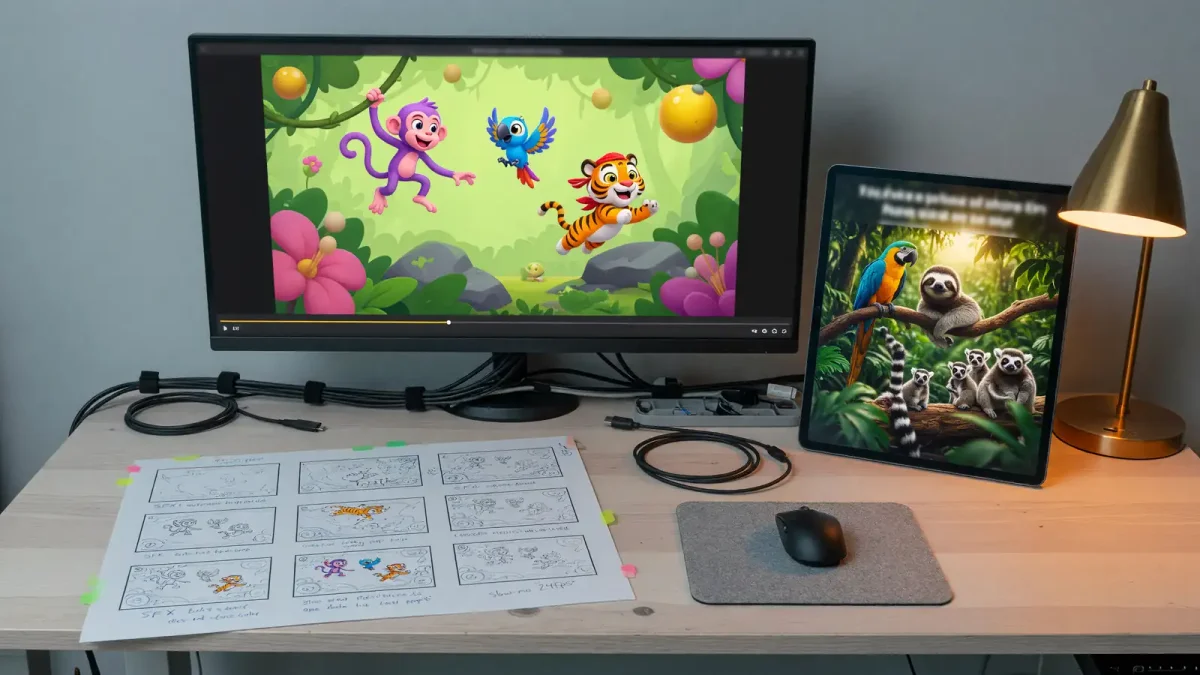
Level-5 put a second apology on its site on September 17. IGN translated the cleanup job on Friday. Nintendo Life called it panic. The same week, ADWEEK crowned an AI ad that opens with a generated toucan and gorilla, then a director yelling that the client no longer wants AI.
One industry is treating the trailer as the product. The other is paying $50,000 in platform credits to keep generating. If you make pictures for a living, those are not the same week.
We already wrote that Firefly is a store and Nano Banana is still the SKU and that the EU made labels mandatory. This week is not a watermark story. It is a distribution story. Fans saw the showcase. The studio is re-uploading YouTube files before Tokyo Game Show. The ad world ran a contest that scores “realism.”
The showcase is the game, for a week
VISION 2026 II: Dreams went on YouTube on September 10. A cartoon Akihiro Hino walked Yokai Watch 2: Haunted Domain, Decapolice, and a first look at Professor Layton and the New World of Steam. The Nintendo Direct for Yokai Watch 2 had run on September 9. People put the two trailers next to each other. Backgrounds and “AI slop” comments filled the replies. The Curious Village remake Direct trailer got the same treatment: original DS backgrounds next to the new ones, weird details, suspected upscales.
Hino posted on X that the studio had tried AI processing on the showcase because it wanted the presentation flashy. Story, character designs, and settings, he said, were made by people. AI was there to speed digitizing. No “simplistic, AI-generated data” in the released games. The five-year cycle for big titles is supposed to become two.
That last sentence is the actual product claim. The trailer is a promise about labor. Fans heard “flashy” and “faster” in the same breath as “trust us about the ROM.” IGN quotes Japanese users asking why a trailer exists if not to show craft. One commenter said that even one AI asset means people never stop asking which song, image, or line is fake.
The TGS booth concept art also got flagged. That is not a shipping build. It is still a picture with Level-5 on it. For an art-driven studio, the picture is the job interview.
September 17 is a YouTube patch
The new statement is dated September 17. Deep apology for inexperienced AI use and simple human errors. AI “has not been used directly in the contents of the games themselves.” They will clean “errors caused by AI use, as well as human mistakes that look like AI errors,” and put corrected trailers up to match TGS, which opened to the public this weekend. IGN noted TGS versions of Decapolice and Holy Horror Mansion already on the official channel.
Then the side-by-sides. Yokai Watch 2 promotional illustration, before and after. Telephone lines looked unnatural. The studio said an in-house designer used a photo they took, simplified the lines to fit the background, and people read that as AI. They redrew the lines to look more natural anyway. Vending machine and guttering: omitted details, called human error. Bicycle brake levers were not in older Yokai Watch 2 art; they think they should be there now because the new game is sharper.
Nathan, also called Kenta, has a different face in VISION 2026 II than in the Direct a day earlier. Level-5 said it did not use AI to alter him. The low-poly model missed the Direct deadline. They updated it for their own show. That explanation is mechanical. It is also the kind of sentence you only publish after a comment section has already decided.
Nintendo Life quotes the forward-looking bit: limit AI to efficiency improvements, do not use it directly in videos delivered to users. New World of Steam will not include any AI. Curious Village remake: no such line.
Read that gap. The new Layton game got a clean sentence. The remake of a DS background-heavy mystery did not. IGN says the studio also did not comment on whether AI was used for Curious Village. If you are buying the remake for the art, that is the unanswered ticket.
The comment IGN closes on is the one that matters for anyone shipping images: people were not mad at the little errors. They used the errors to detect AI. Cleaning the tell is not the same as dropping the tool. One reply said the studio will keep using AI and hide it better. Another asked why the statement dumped “human error” on staff while the president keeps promoting generative AI without talking about training data.
They have been saying this since 2023
IGN’s background is not this week, but it explains why the apology sounds familiar. In December 2023 Level-5 presented to a Japanese government study group (Automaton and ITMedia). Stable Diffusion for promotional layouts. 2D Yokai Watch models pushed toward 3D, as guidelines. Human artists for finals. Inazuma Eleven: Victory Road backgrounds mixed AI pieces with artist work for stadium crowds and buildings.
That is a pipeline, not a one-off flashy reel. The September 17 promise to keep AI for “efficiency” is the 2023 slide with the public trailer stripped out. If you are an in-house illustrator, “efficiency” is still a layout you did not draw. If you are a fan, the trailer was the only art you were going to see until ship.
We already covered how provenance tracking is changing credit. Level-5 is doing the inverse: a press note that some weird gutters were human. Provenance would have been a file. A statement is a vibe.
Document the process if you care, as we said in why every AI artist should document their process. Level-5 documented after the Direct comparison. That is late.
The adathon paid the other way
Justin Chin’s ADWEEK piece is dated September 16, two days before the IGN writeup. Higgsfield, with ADWEEK, ran an Adathon: skip the pitch deck, produce the spot. AI-R Studio, the production arm of Mexico-based Pico.Love OS, won.
The winning film opens on AI toucan and gorilla in a jungle. A director yells cut, they no longer want AI. The gorilla is replaced by a person in a suit who cannot breathe. Then a “Video Killed the Radio Star” needle drop, a fish begging in a sushi restaurant, mechs asking if they are still shooting. Tag: “Don’t kill the AI stars. They’re just trying to improve your video.”
The credits list one creative prompt artist and five prompt artists. The prize is $50,000 in credits on Higgsfield’s AI media platform, which ADWEEK says musicians including Snoop Dogg, Madonna, and Will Smith have used. Judges equally weighted creative idea, brand storytelling and effectiveness, craft (camerawork, sound), and realism. The panel: Zoë Ruderman of ADWEEK, AJ Coyne of Monzo, Elav Horwitz of WPP, plus Higgsfield’s Michael Ventura and Linda Bethea.
Realism is a judging criterion in a contest that is proud of generated animals. Level-5 is spending the same week redrawing telephone lines so they look less generated. Both are true. They are not the same buyer.
If you make game key art, the Level-5 week is your customer. If you make pre-vis for a brand that already bought Higgsfield seats, the Adathon is your customer. Do not send the second client a manifesto about the first. Do not send the first client a jungle gorilla.
The joke in the winning spot is that the industry might kill AI stars. The prize is more credits. That is not a studio walking a trailer back. That is a vendor paying you to stay on the meter.
Craft, in that rubric, includes camerawork and sound design. Realism is a quarter of the score. Level-5 is arguing that a simplified telephone line was a human choice that looked generated. ADWEEK’s judges would have scored the same line as a realism miss. One room is hunting tells. The other is grading them.
Pico.Love OS calls the job “prompt artist.” Six names on a 30-second joke about killing AI stars. Level-5 will not put AI in the fan video and will not say what happened on Curious Village. If you are hiring, those are two job descriptions. Do not write one posting for both.
What to ship this week
If you are on a game team with a public reel before a show, treat the reel as a build. Level-5 is re-encoding YouTube files because the showcase was the first playable the internet got. A “flashy” pass is a patch. Hino’s two-year cycle pitch does not help if the ten-minute video is what people remember.
Write down, in the file, whether a still is layout, upscale, or final. Curious Village’s silence is the expensive part. New World of Steam got a sentence. The remake did not. Silence reads as “maybe.”
If you are on an ads team, the Adathon criteria are the brief: idea, story, craft, realism. Credits as prize means the platform wants you generating more, not less. “Prompt artist” is already a credit line. That will collide with how galleries are hanging this work and with any client who watched a Layton comment section.
Do not split the difference in one still. A trailer that is “mostly human” with a generated crowd is the Inazuma pipeline from 2023, now with a fan microscope. An ad that is all generated and jokes about it is a different contract. Pick the contract before you pick the model.
TGS is this weekend in the IGN piece. Corrected Decapolice and Holy Horror Mansion files are already up. Watch whether Curious Village gets a line. Watch whether the Adathon winners spend the credits on another gorilla. Those are the two dashboards. They do not share a leaderboard.
Hino still wants a two-year cycle. The comment section still wants a five-year one with no generated pixels. You will not reconcile that in a blog. You can refuse to ship a reel that is the first time the public sees the art. You can refuse a contest whose prize is more of the tool the other timeline is hiding. Both refusals are product decisions. They just are not the same product.