ChatGPT's Market Share Fell Below 50%: What Sensor Tower and StatCounter Data Show About Gemini, Claude and the AI Assistant Market
Sensor Tower's State of AI 2026 report put ChatGPT's share of AI assistant usage at 46.4% at the end of May 2026, with Gemini at 27.7% and Claude at 10.3%. How these figures are measured, why trackers disagree, what is driving fragmentation and what it means for choosing AI tools.
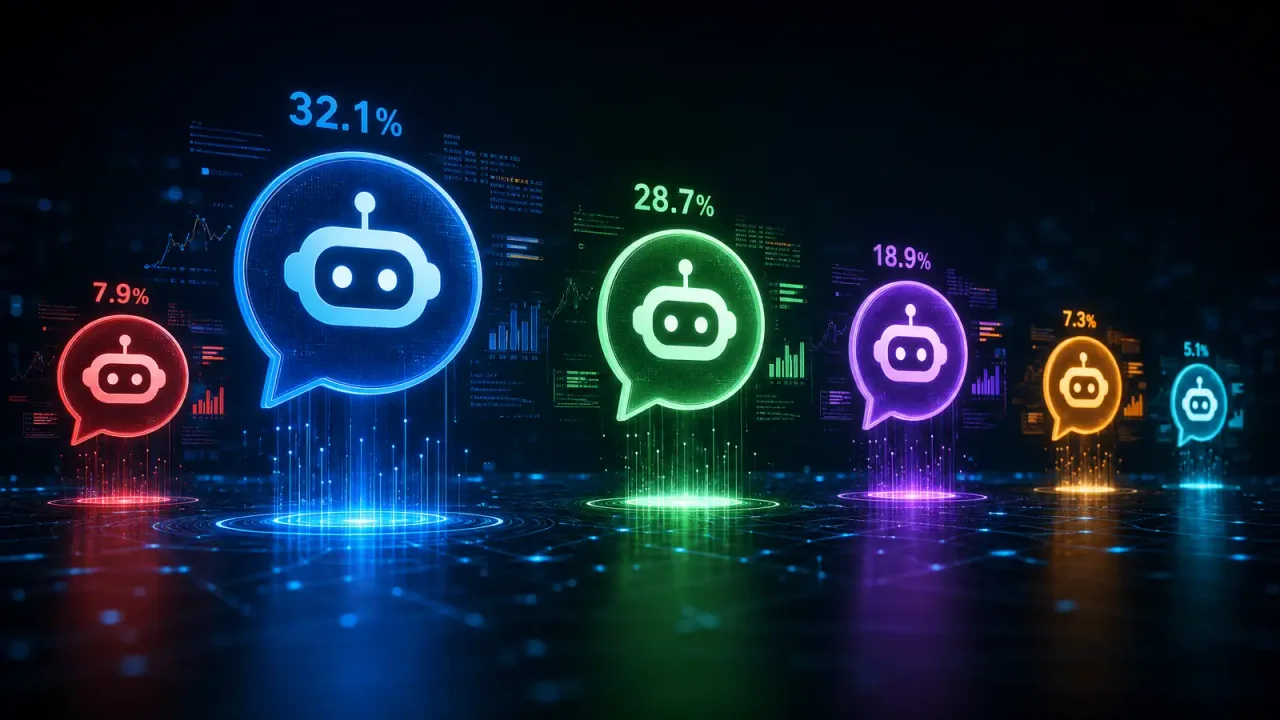
ChatGPT is still the world’s most popular AI assistant, but it no longer holds a majority of the market by at least one major measure. According to Sensor Tower’s State of AI Report for 2026, reported by TechCrunch on June 16, 2026, ChatGPT held more than 50% market share until January 2026 but fell to 46.4% by the end of May, as Google’s Gemini rose to 27.7% and Anthropic’s Claude to 10.3% (TechCrunch). Other trackers measure differently and disagree: StatCounter’s web-referral series still showed ChatGPT just above half in October 2026. The common thread is that the market is fragmenting as users switch between assistants and AI is built into products they already use.
What the data shows
| Source | What it measures | ChatGPT | Gemini | Claude | Others |
|---|---|---|---|---|---|
| Sensor Tower, end of May 2026 | AI assistant app usage share | 46.4% | 27.7% | 10.3% | Remainder (e.g. Grok, Meta AI) |
| StatCounter, October 2026 | Share of referral traffic from AI chatbots to websites | 51.58% | 28.86% | 2.3% | Perplexity 15.04%, Copilot 2.18% |
Sources: TechCrunch on Sensor Tower; StatCounter, figures read on November 12, 2026.
Sensor Tower also reported that ChatGPT was the fastest app ever to reach one billion monthly users, with Gemini at 662 million and Claude at 245 million, and that users are increasingly willing to switch between assistants. Absolute usage can keep growing even as share falls, because the whole market is expanding.
Why the trackers disagree
Market share figures come from third-party panels and traffic estimates, not from the companies’ own user counts:
- Sensor Tower estimates mobile app usage from its panel and app store data, so it captures app-based use but not necessarily desktop web use.
- StatCounter measures referral traffic from AI chatbots to websites in its tracking network. That favours tools whose answers send users to links, which is one reason Perplexity scores much higher there than in app-usage data, and Claude lower.
- Similarweb estimates website visits to chatbot domains (Similarweb).
None of these fully capture assistants built into other products, such as Gemini in Android or Copilot in Windows and Office, or usage through APIs. Different methods can disagree by many percentage points, so it is better to watch trends within one source than compare numbers across sources.
What is driving fragmentation
Distribution. Google can surface Gemini in Android, Chrome, Search and Workspace; Microsoft builds Copilot into Windows and Office. Assistants that are already there when people need them win usage without a separate download.
Specialised tools. Many people now use different tools for different jobs: coding assistants such as GitHub Copilot or Cursor for programming, Perplexity for cited research, and dedicated image or video generators for creative work.
Model competition. Model quality among leading labs has converged, so users can switch based on features, price, integrations or personal preference without a big drop in capability. Claude, for example, has a strong following among developers and professional writers.
Multi-homing. Sensor Tower’s finding that users increasingly switch between assistants suggests many people use more than one, which naturally dilutes any single product’s share.
A familiar pattern
Software markets often follow a similar arc: a breakthrough product takes early dominance, competitors catch up and the market fragments, then it consolidates around a few leaders with different strengths. Web browsers and search are imperfect analogies, but they show that distribution through operating systems and existing products tends to matter as much as first-mover advantage.
What this means for users and businesses
For individuals, more competition means better features and more choice. It is worth trying more than one assistant for tasks you do often, since strengths differ.
For businesses, the “just use ChatGPT” default is weaker than it was in 2024:
- Check what you already pay for. Workspace and Microsoft 365 plans increasingly include assistants that may cover common needs.
- Match tools to tasks. Specialised tools may outperform general assistants for coding, research or design.
- Avoid lock-in. Use model-agnostic tooling where possible, so you can switch providers as prices and capabilities change.
- Review data policies. Enterprise terms on data retention, training and residency differ between providers.
Choosing an assistant in a fragmented market
Rather than picking by brand or market share, start from how you work:
| If you mainly | Consider | Why |
|---|---|---|
| Live in Google Workspace and Android | Gemini | Built into Gmail, Docs, Chrome and Android |
| Use Microsoft 365 and Windows | Microsoft Copilot | Integrated with Office apps and Teams |
| Want a broad general assistant with many features | ChatGPT | Wide feature set, large ecosystem of integrations |
| Write long documents or code extensively | Claude | Popular with developers and writers for long-context work |
| Research topics and need sources | Perplexity | Answers built around citations and links |
Whichever you choose, run the same handful of real tasks through two or three options before committing, and revisit the choice periodically. Leading assistants update models and features often, so a ranking that held six months ago may not hold today.
Common questions
Does falling share mean ChatGPT is declining? Not necessarily. The overall market grew rapidly, and Sensor Tower reported ChatGPT reaching one billion monthly users. Share fell because rivals grew faster.
Why is Perplexity so high in StatCounter’s data? StatCounter counts referrals to websites. Perplexity’s answers are built around source links, so its users click through to sites more often than users of assistants that answer directly.
Will one assistant regain a majority? It is possible, but the strength of built-in distribution from Google, Microsoft and Apple, plus users’ willingness to switch, makes a lasting plurality more likely in the near term.
What to watch next
Three indicators will show whether fragmentation continues. First, whether Gemini’s growth holds as Google pushes it across Android, Chrome and Workspace. Second, whether Claude’s gains among professional users translate into broader consumer usage. Third, how assistants built into operating systems, including Apple’s Siri integrations, change the numbers that app-based and web-based trackers can see. Pricing and free-tier limits also matter: as providers adjust what free users get, casual users tend to move toward whichever assistant is most generous and most convenient.
Our analysis
A share figure crossing below 50% is a symbolic milestone, not a collapse: ChatGPT remains the leader and is still growing in absolute terms. It does point to a real shift, as distribution through operating systems, search and productivity suites now matters as much as model quality, and users are comfortable switching. Because trackers measure different things, treat any single share number with caution and look at trends. For businesses, relying on one chatbot vendor carries more risk than it did in 2023, and building on model-agnostic tooling is prudent.