'Botsitting' Explained: Why UK Workers Lose 5.8 Hours a Week Managing AI Tools, and How to Cut the Overhead
What Glean's Work AI Index: UK 2026 found about botsitting (5.8 hours a week supplying context to and checking AI tools, 36% of sessions failing), related research on workslop and METR's developer study, why supervision eats productivity gains, and practical steps to reduce it.
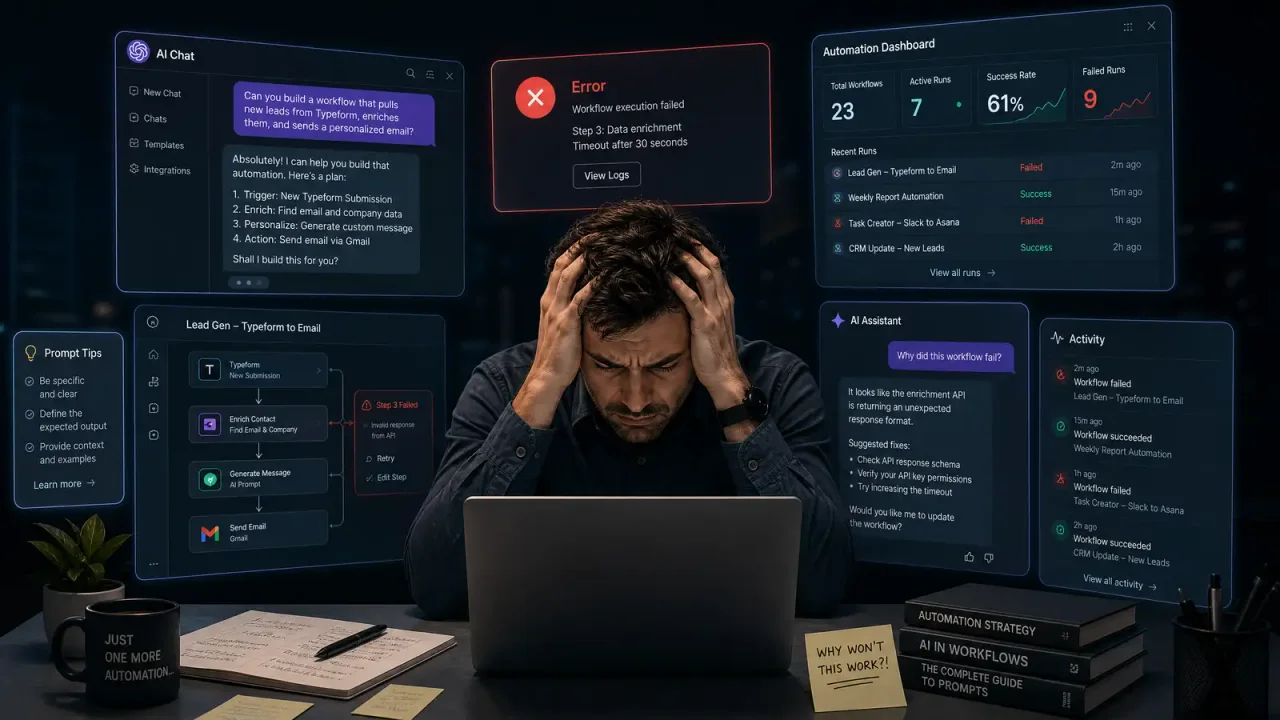
AI tools save many workers time, but supervising them takes back a large share of it. The Work AI Institute, a research arm of Glean Technologies, surveyed 1,500 UK digital workers for its Work AI Index: UK 2026 and found they spend an average of 5.8 hours a week “botsitting”: feeding AI tools context they should already have, checking outputs and fixing failures (The Register, Glean). Workers said AI saved them roughly 12 hours a week, so the net gain is real but much smaller than it looks. The fix is to delegate tasks whose outputs are cheap to verify, give tools better context and measure supervision time honestly.
What the survey found
All figures below are from the Work AI Institute’s survey as reported by The Register. Glean sells AI workplace software, so treat these as company-reported findings.
| Finding | Figure |
|---|---|
| Workers surveyed | 1,500 UK digital workers |
| Required to use AI in their roles | 90% |
| Use multiple AI tools every week | 80% (39% use four or more) |
| Time AI saves, by workers’ estimate | About 12 hours a week |
| Time spent botsitting | 5.8 hours a week on average |
| AI sessions that fail outright, needing a restart or substantial rework | 36% |
| Pass on the first output that looks “good enough” | 70% |
| Agree AI has significantly improved their organisation’s performance | 18% |
According to the report, botsitting time goes mainly into two activities: loading the context window with information the AI should already have, and overseeing output, meaning reviewing answers and trying to catch results that are wrong, incomplete or missing context.
The 70% figure is arguably the most worrying. The report says workers eventually tire and cut corners, checking outputs and sources less diligently. That turns a time cost into a quality risk: errors pass silently into documents, decisions and code.
Why botsitting happens
Missing context. Many AI tools start each session knowing nothing about the user’s project, company or preferences. Re-explaining background is a recurring tax, and outputs built on thin context need more correction.
Tasks that are expensive to verify. Checking an AI-written summary against a long source document can take nearly as long as writing the summary. When verification is costly, the time saved by generation shrinks.
Over-ambitious delegation. Tasks involving judgement, ambiguous instructions or many steps fail more often. Each failure means re-prompting, restarting or doing the work by hand anyway.
Tool sprawl and fragile integrations. With many workers using four or more AI tools, switching between them and fixing broken connections to email, chat, CRMs and project systems adds overhead.
Related research on hidden AI overhead
- “Workslop”: Researchers at BetterUp Labs and the Stanford Social Media Lab coined this term for AI-generated work that looks polished but lacks substance, leaving the recipient to fix it. In their survey of U.S. desk workers, about 40% said they had received such content in the past month, and respondents estimated each incident took nearly two hours to deal with (Harvard Business Review, September 2025).
- Perception gap: In METR’s 2025 randomised trial, experienced open-source developers expected AI to speed them up, but measured completion times were about 19% slower; part of the extra time went into prompting, waiting for and reviewing AI output (arXiv:2507.09089).
- Demand for supervision skills: PwC’s UK AI Jobs Barometer, reported by The Register, found employers increasingly hiring people who can use and oversee AI rather than build it (The Register).
Together, these suggest that self-reported time savings can overstate real gains, and that the cost of checking AI work often lands on someone other than the person who generated it.
How to reduce botsitting
1. Delegate verifiable tasks first
Start with tasks where correctness can be checked cheaply: tests for code, schemas for structured data, source links for research, or simple comparisons against a known answer. Expand to harder tasks only once error rates are acceptable.
2. Give tools persistent context
Use features such as project instructions, shared knowledge bases, templates and rules files so tools do not need re-briefing each session. Well-maintained context reduces both setup time and correction time.
3. Build in automatic checks
Add validation steps where possible, such as range checks on numbers, required citations, format validation and spell or style checks, so that humans review only what automated checks cannot catch.
4. Prefer tools that show their work
Choose tools that cite sources, explain what they did, flag uncertainty and let you set guardrails such as scope limits and approval steps before actions are taken.
5. Measure the whole cycle
Track time end to end, including review and rework, not just generation. If a use case takes longer to supervise than to do by hand, drop it or redesign it.
6. Consolidate tools
Fewer, better-integrated tools reduce switching costs and the number of integrations that can break.
Questions for managers
Before rolling out another AI tool, it is worth asking:
- Which tasks will it take over, and how will we know its output is correct? If there is no cheap way to check, expect botsitting.
- Who reviews the output, and is that time budgeted? Review work often falls on colleagues downstream, as the workslop research shows.
- What context does the tool need, and who maintains it? Out-of-date instructions and knowledge bases cause repeated errors.
- How will we measure success? Combine time saved with error rates, rework and user satisfaction, not just usage statistics.
- What happens when it fails? A clear fallback avoids people improvising fixes under pressure.
Our analysis
Botsitting is the predictable result of delegating work whose outputs are expensive to check, with tools that lack context. Every AI output has to be verified, and the cost of verifying depends on how easy errors are to spot: a broken unit test is obvious, a subtly wrong figure in a summary is not. The survey’s net picture, about 12 hours saved against 5.8 spent supervising, shows AI is still worth using for many workers, but the 70% who pass on “good enough” output point to a quality problem that time-tracking will not reveal. Organisations should treat AI deployment as a management and workflow design task, measuring supervision time and output quality, not just adoption.