AI as a Creative Collaborator: What Research Shows, Artist Case Studies, Collaboration Patterns and Authorship Rules
How artists, musicians and writers work with AI as a collaborator rather than a replacement: the Doshi and Hauser experiment on creativity and sameness, Holly Herndon's Spawn and Holly+, Refik Anadol's data works, Google Magenta, practical collaboration patterns, and what the U.S. Copyright Office says about authorship.
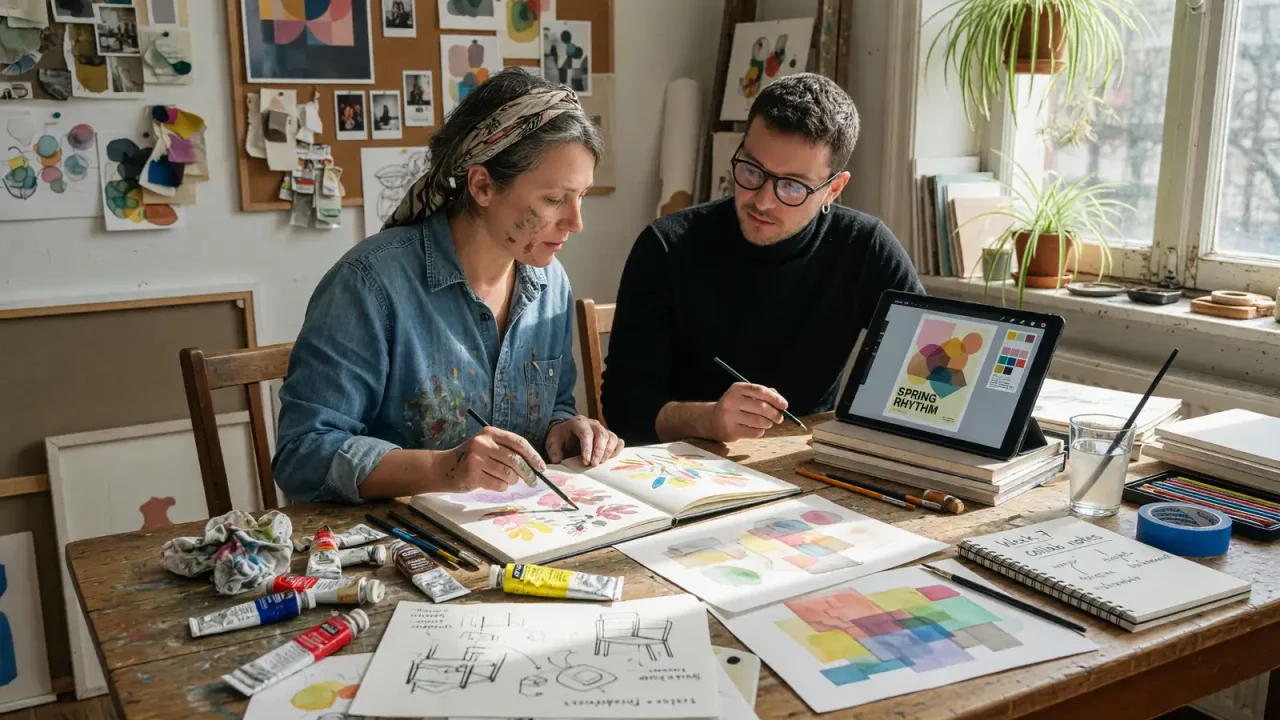
AI tends to make individual creative work better on average while making work as a whole more alike. That is the key finding of the best-known experiment on the subject, and it shapes how to collaborate with AI well. The most interesting AI-assisted work comes from people who bring their own constraints, references and taste, using AI to generate options, critique drafts or handle production chores while keeping the consequential decisions human. This guide looks at the research, notable artist collaborations, patterns that work and the copyright rules on authorship.
What the research shows
In an online experiment published in Science Advances in 2024, Anil Doshi and Oliver Hauser let some writers draw story ideas from a generative AI tool (preprint, arXiv:2312.00506). Access to AI ideas made stories rated as more creative, better written and more enjoyable, with the biggest gains among the less creative writers. But the AI-assisted stories were more similar to one another than stories written by humans alone.
| Finding | Implication |
|---|---|
| AI ideas raised individual creativity ratings | AI can help people get unstuck and raise the floor |
| Gains were largest for less creative writers | AI may narrow skill gaps on some tasks |
| AI-assisted stories were more similar to each other | Heavy reliance can reduce diversity across a body of work |
In effect, this is a social dilemma: each writer may be better off using AI, but collectively the range of ideas shrinks. For working creatives, distinctiveness is often the point, so the finding is a warning against taking the first suggestion.
The collaboration spectrum
AI-human collaboration ranges from AI as a tool, like a sophisticated brush executing the artist’s intent, to AI as a generator of ideas the artist curates and develops. Most professional practice sits in between. A musician might generate variations on a motif, keep one fragment, develop it by hand and use AI-assisted tools for mixing. The AI proposes; the human decides what is worth keeping.
Case studies
| Artist or project | Approach | Source |
|---|---|---|
| Holly Herndon and Mat Dryhurst | Trained a singing neural network, Spawn, for the 2019 album Proto; launched Holly+ in 2021, a voice model and protocol for others to use Herndon’s voice | Wikipedia, Holly+ |
| Refik Anadol | Uses machine learning to turn large datasets into immersive visual works, such as the Machine Hallucinations series and Unsupervised | Wikipedia |
| Google Magenta | Open-source research project on machine learning as a tool in the creative process, including real-time music models and plugins | Magenta |
Holly Herndon and Mat Dryhurst have explored AI and identity for years. On Proto, they worked with a neural network called Spawn, trained largely on Herndon’s own voice, as a member of the ensemble. Holly+ went further, letting others create with a model of her voice under a framework designed to address deepfake concerns. Their work treats the AI voice as an extension of the artist rather than a substitute.
Refik Anadol builds works from datasets far too large for any person to view, such as archives and nature imagery, but the artistic decisions about data, process and presentation are his studio’s. Unsupervised, based on the Museum of Modern Art’s collection, was exhibited at MoMA. For more on AI in museums and galleries, see our guide to AI art galleries and exhibitions.
Google Magenta has released open models and tools for music and art, framing machine learning explicitly as a creative instrument rather than an autonomous composer.
How the creative process changes
Artists who work extensively with AI often describe a more iterative, exploratory process: generate many variations, select, refine, combine and generate again. The role shifts toward direction and curation, and the most valuable skill becomes judgement, recognising what is good, surprising and worth developing.
This is contested. Many artists argue that the struggle of making is how they discover what they want to say, and that skipping it produces shallower work. Others see AI as removing barriers between an idea and its realisation. Both can be true for different people and projects.
What AI does not bring
AI systems do not have intentions, a stake in the work or an understanding of what a piece means in relation to an artist’s history and culture. They tend to reproduce the patterns most common in their training data, which is one explanation for the sameness effect in the Doshi and Hauser study. That is why collaboration works best when the human supplies the “why” and the distinctive constraints, and AI contributes to exploration and production.
Collaboration patterns that work
- AI as a divergent generator: produce many rough options, then select and develop them by hand.
- AI as a critic: ask for weaknesses, clichés or inconsistencies in a draft you wrote yourself.
- AI with constraints: feed it your own references, sketches, palettes or rules rather than generic prompts.
- AI for production chores: clean-up, resizing, rotoscoping, transcription and format conversion.
- Write first, prompt second: form your own idea before asking for suggestions, to avoid anchoring on the AI’s.
Authorship and copyright
The U.S. Copyright Office’s 2025 report on copyrightability concluded that human creative contributions remain protectable, including the selection, arrangement and modification of AI output, but that prompts alone generally are not enough (U.S. Copyright Office). Keeping records of your process, including drafts, edits and the choices you made, helps with registration and with transparency toward clients and collaborators. Our guide to AI art and copyright law covers the legal questions in more depth.
Common questions
Will using AI make my work look generic? It can, if you accept default outputs. Using your own references, unusual constraints and heavy editing keeps work distinctive.
Should I tell clients or audiences that I used AI? Many clients now ask, and contracts increasingly address it. Being upfront about which parts were AI-assisted builds trust and avoids disputes about ownership.
Is it still “my” work? Ethically and legally, the more creative choices you make, the stronger your claim. Selection, arrangement, editing and the overall concept are human contributions; a single prompt is not.
Our analysis
The Doshi and Hauser result is the central tension: AI raises the floor but can flatten the range. Creators who want distinctive work should use AI deliberately, bringing their own constraints, references and taste and treating AI suggestions as raw material rather than finished ideas. The artists doing the most interesting work, like Herndon and Anadol, design the system and the questions themselves; the AI is part of their medium, not the author.