Meta's Brain2Qwerty v2 Explained: Decoding Typed Sentences from MEG Brain Recordings, Accuracy, Architecture and Ethics
Meta FAIR and academic partners' Brain2Qwerty v2 decodes sentences people type from non-invasive MEG recordings, with 61% average and 78% best-participant word accuracy. How it works, how it compares with v1 and implants, why MEG matters, its limits and the neural privacy questions it raises.
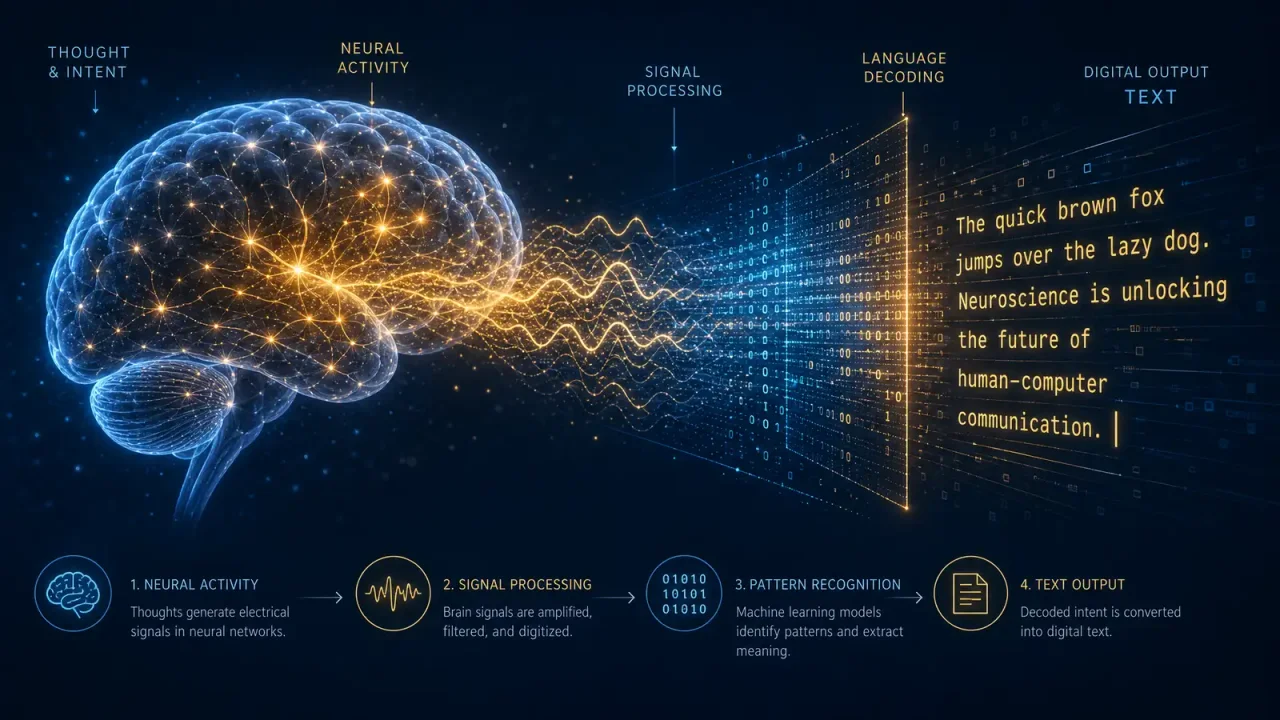
Meta’s FAIR lab and academic collaborators have shown that sentences people type can be decoded from non-invasive brain recordings with much higher accuracy than before. Their system, Brain2Qwerty v2, uses magnetoencephalography (MEG) to reconstruct typed sentences, reaching about 61% word accuracy on average across nine volunteers and 78% for the best participant, roughly doubling the performance of the first version. It decodes brain activity during typing, not arbitrary thoughts, and requires a large, shielded scanner, so it is a research milestone rather than a product. The main promise is restoring communication for people who have lost speech or movement; the main concern is neural privacy as the technology improves.
Key results
| Measure | Brain2Qwerty v1 | Brain2Qwerty v2 |
|---|---|---|
| Typed sentences in dataset | About 2,200 | About 22,000 |
| Participants | Healthy volunteers | Nine healthy volunteers, about 10 hours each |
| Word accuracy, average | 40% | 61% (39% word error rate) |
| Word accuracy, best participant | 48% (52% word error rate) | 78% (22% word error rate) |
| Approach | Pipeline with hand-crafted keystroke detection | End-to-end decoding of whole sentences |
Sources: project page, Meta AI publication (paper dated June 29, 2026, under review) and code repository.
For the best participant, the authors report that about half of sentences were decoded with one word error or fewer. They also report that accuracy improves log-linearly with more data, suggesting further gains from scale, although invasive implants still perform better.
How it works
A participant sits in an MEG scanner and types sentences on a keyboard while the scanner records the magnetic fields produced by brain activity. Earlier pipelines first detected individual keystroke events with hand-crafted steps. According to the official code repository, v2 instead decodes whole sentences from a continuous MEG window and jointly trains three components:
- A neural encoder: convolutional layers and a Conformer network with a character-level CTC output head.
- A word-level contrastive objective: aligns neural word representations with a language model’s embeddings.
- A LoRA-adapted language model: generates the sentence from the encoded brain signals.
The team also used AI agents to explore optimisations of the decoding pipeline, with final configurations chosen by engineers. The authors highlight three AI-driven sources of improvement: deep learning replacing hand-crafted steps, fine-tuned language models and agent-assisted code development.
Is the language model just guessing?
A natural worry is that a powerful language model could produce fluent sentences regardless of the brain data. The authors’ ablations address this: removing the MEG-derived inputs from the language model substantially worsens results, indicating the system draws real information from brain signals rather than relying on language priors alone. This fits a broader body of research linking brain activity to the internal representations of language models, a line of work that could benefit both neuroscience and AI.
Why MEG
| Method | What it measures | Strengths | Limits |
|---|---|---|---|
| fMRI | Blood-flow changes | Good spatial detail | Slow, indirect signal |
| EEG | Electrical activity at the scalp | Cheap, portable | Skull blurs the signal; poor spatial resolution |
| MEG | Magnetic fields from neural activity | Millisecond timing and better spatial detail than EEG | Expensive, rare, needs a magnetically shielded room |
| Implanted electrodes | Activity directly from brain tissue | Highest accuracy | Requires surgery, with associated risks |
Magnetic fields pass through the skull with little distortion, which gives MEG a useful combination of temporal precision and spatial resolution. The trade-off is hardware: MEG systems are costly and require shielded rooms, so this is not something anyone will wear at a desk. The point of the research is to show the signal is there and can be decoded far better than previously thought.
Who could benefit
The authors frame the work around restoring communication for people who have lost the ability to speak or move after brain injury or disease. Implanted brain-computer interfaces have achieved impressive results for some patients, but surgery is not appropriate or acceptable for everyone. Better non-invasive decoding could widen access, especially if wearable sensors, such as optically pumped magnetometers, eventually make MEG-like recording more practical.
Limits
- Typing required: participants were healthy volunteers who could type; decoding for people who cannot move may work differently.
- Per-person data: each participant contributed many hours of recordings, and models depend heavily on individual data.
- Lab conditions: results come from controlled sessions in a shielded scanner.
- Under review: the paper had not completed peer review at publication.
The privacy questions
Brain2Qwerty v2 only works when a willing participant is actively typing inside an MEG scanner; it cannot read passive thoughts or work remotely. But if accuracy keeps improving and hardware becomes smaller and cheaper, the ethical questions will sharpen. Neural data could reveal far more than intended, and there is a risk of use in settings where consent is not freely given, such as employment screening or interrogations. Writers on neuroprivacy warn that regulatory gaps could allow neural data to be decoded and traded without adequate safeguards, and argue that protections should depend on the source, sensitivity and intended use of the data. The debate about rights over brain data is likely to intensify as decoding improves.
Common questions
Can this read my thoughts? No. It decodes brain activity associated with typing sentences, in a scanner, from volunteers who trained the system with many hours of their own data. It does not decode passive or private thoughts.
How does it compare with implants? Implanted devices remain more accurate and faster, but require surgery. Non-invasive systems trade accuracy for safety and accessibility.
When could this become a product? The authors do not give a timeline. Practical use would need more portable hardware, less per-person training data and validation with people who have lost speech or movement.
Is the code available? Yes. The team published code on GitHub alongside the paper, which allows other researchers to test and build on the method.
Our analysis
Brain2Qwerty v2 is a substantial step for non-invasive brain-to-text decoding: a roughly twofold accuracy gain, an end-to-end architecture and evidence that the system extracts real information from brain signals. It is still far from a practical assistive device, and implants remain more accurate. The most important follow-up questions are whether the approach works for people who cannot move, whether it can run on more portable hardware and how neural data will be protected. Safeguards are easier to build in while the technology is still confined to the lab.