Godot's 2026 AI Contribution Policy: No Vibe Coding, Human-Authored Code and Limits on New Contributors
On June 30, 2026 the Godot Foundation announced stricter contribution rules: no autonomous AI agents or vibe coding, human-authored code with AI disclosure, no AI-written messages, and no new features from contributors with three or fewer merged PRs. What changed, why, and how it compares with Gentoo, NetBSD and QEMU.
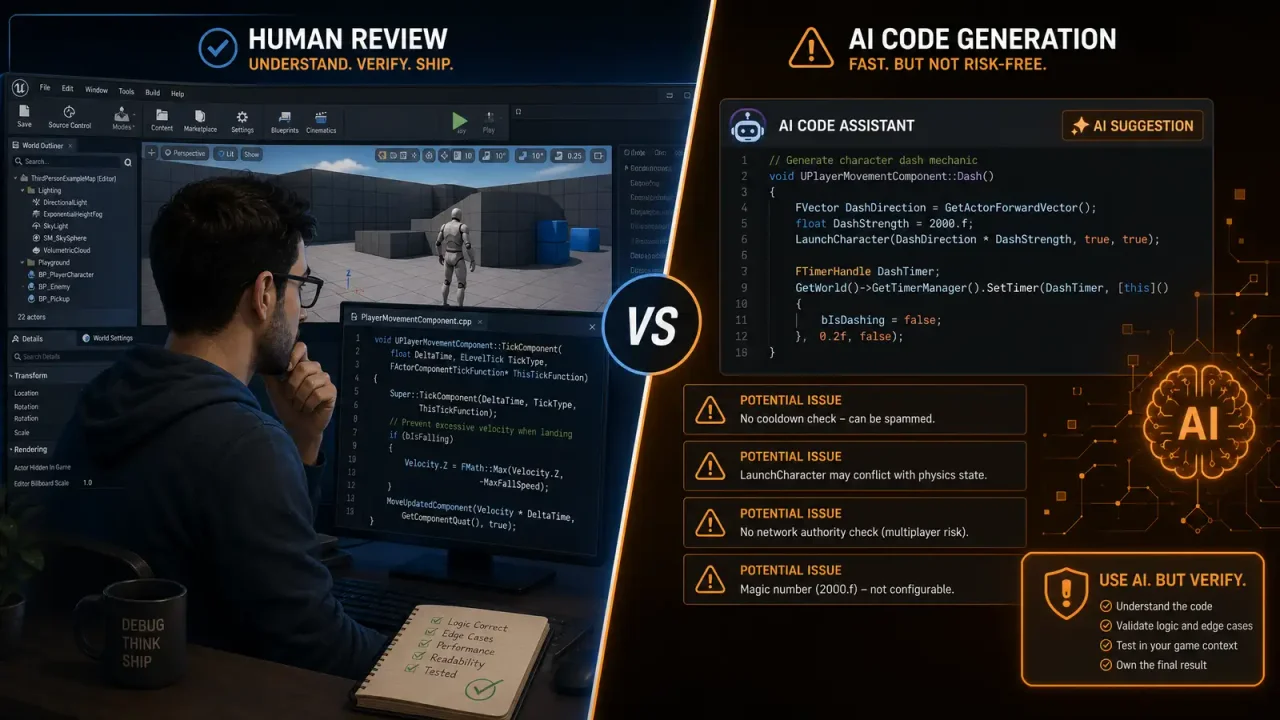
On June 30, 2026, the Godot Foundation announced stricter contribution policies for the open-source game engine, aimed at a growing backlog of pull requests and a rise in AI-generated submissions (Godot Foundation). Autonomous AI agents and “vibe coding” are banned, code must be human-authored with AI help limited to menial tasks and disclosed, AI-written text is not allowed in conversations with maintainers, and new contributors cannot submit new features or major refactors without maintainer permission. Godot’s reasoning is less about AI itself than about reviewer capacity and the project’s pipeline for training future maintainers.
What the policy says
| Rule | Detail |
|---|---|
| No autonomous AI agents or vibe coding | Already leads to an automatic ban from Godot’s GitHub repository |
| No AI-generated substantial code | All code must be human-authored; AI limited to “menial things (like code completion, regex, or find and replace)“ |
| Disclosure | Any AI use in authoring code must be disclosed in the PR discussion |
| No AI-generated text in human communication | Applies to issues, PRs and proposals; machine translation of human-written text is still allowed |
| Human review | All PRs must be reviewed and approved by a human before merging, now stated explicitly |
| Limits on new contributors | No new features or significant refactoring without explicit maintainer permission for anyone with three or fewer merged PRs |
The new-contributor rule is already in Godot’s rules for contributions, which also remind contributors that code from elsewhere, “including code generated by AI,” may be subject to copyright or patent rights and must be compatible with Godot’s MIT license.
Why Godot made the change
The Foundation’s announcement is candid. Its maintainers had “become overwhelmed by the large number of code contributions,” and the backlog of open PRs “has become a meme in the community.” The underlying problem is a small number of qualified reviewers. AI made it worse: “The amount of effort required to make a PR has gone down (and number of PRs has increased as a result), while the amount of work to review PRs and the amount of people available to review has stayed the same.”
The Foundation also describes a human cost. Reviewing is tedious but rewarding when it educates a new contributor who may become a future maintainer. “If your feedback on PRs is just being absorbed by a machine and not going towards mentoring a potential future maintainer, it becomes much harder to justify spending your free time on PR review.”
It sets out four aims:
- Grow future maintainers. “LLMs can’t learn from specific feedback and thus can’t benefit from maintainers providing feedback.”
- Ensure accountability. Contributions must come from humans who can take responsibility for their code and fix it later. “AI cannot take responsibility, and we can’t trust heavy users of AI to understand their code enough to fix it.”
- Add barriers to low-effort slop, without cutting off the maintainer pipeline.
- Make PR review more rewarding, since review is the engine’s biggest bottleneck.
The board and maintainers had discussed the policy for several months, and the Foundation says it will “re-evaluate as things evolve.”
The vibe coding problem
“Vibe coding” is the term Andrej Karpathy popularised in February 2025 for prompting an AI to write code and accepting the result without closely reading it (Wikipedia). For prototypes and personal projects that can be productive. For a large shared codebase it shifts work onto reviewers: code can look plausible, pass superficial checks and still break in edge cases or interact badly with other systems, and the person who submitted it may not understand it well enough to fix it.
Godot attracts contributors of all experience levels, from professional engine programmers to hobbyists fixing their first bug. That openness is a strength, but it means maintainers must triage a wide range of quality. When generating a patch takes minutes and reviewing it takes hours, the economics of volunteer review break down.
How Godot compares with other projects
Godot is not the first open-source project to restrict AI-generated contributions, and its policy is more permissive than some:
| Project | Policy | Main rationale |
|---|---|---|
| Godot (2026) | Human-authored code; menial AI help allowed with disclosure; agents and vibe coding banned | Reviewer burden, maintainer pipeline, accountability |
| Gentoo (April 2024) | Forbids contributions created with the assistance of natural language processing AI tools | Copyright, ethical and quality concerns |
| NetBSD | LLM-generated code “presumed to be tainted code”; needs prior written approval by core | Licensing and provenance |
| QEMU | Declines contributions believed to include or derive from AI-generated content; AI for research, static analysis or debugging allowed if output isn’t included | Developer’s Certificate of Origin and unsettled copyright status |
The differences are instructive. Gentoo, NetBSD and QEMU lead with legal provenance: contributors must be able to certify the licence status of what they submit, and the copyright status of AI output is unsettled. Godot mentions copyright in its contribution rules, but its 2026 announcement leads with something more practical: review capacity and the social contract between maintainers and contributors.
What changes in practice
For experienced contributors who already understand and test their code, little changes beyond disclosing any AI use. The policy targets a specific behaviour: submitting code the contributor did not write and may not understand. What is new is that maintainers can now decline such PRs on policy grounds rather than arguing about quality case by case.
The new-contributor rule may matter as much as the AI rules. Requiring people with three or fewer merged PRs to start with bug fixes and documentation, and to get permission before large features, filters out drive-by submissions whether or not AI wrote them, and pushes newcomers into the kind of interaction with maintainers that builds trust.
Enforcement is the open question. Detecting AI-generated code reliably is hard, so the policy depends largely on honesty, disclosure and reviewers’ judgment. Its real force may be cultural: it signals clearly what the project values and gives maintainers backing when they close low-effort PRs.
Lessons for other projects and teams
- Write the policy down. Clear rules on AI use, disclosure and accountability save maintainers from relitigating each case.
- Protect reviewer time. Limits on scope for new contributors and one-change-per-PR rules reduce review load regardless of AI.
- Require disclosure. Knowing when AI was involved helps reviewers decide where to look harder.
- Keep humans accountable. Whoever submits the code must be able to explain and maintain it.
- Revisit regularly. Tools change quickly; Godot explicitly plans to re-evaluate.
For how AI coding assistants are changing professional development work, see our overview of the AI coding tools landscape.
Our analysis
Godot’s policy is best read as a reviewer-capacity measure rather than an anti-AI statement. Volunteer open-source projects depend on scarce review time and on turning newcomers into maintainers, and low-effort AI-generated PRs undermine both while producing contributors who cannot learn from feedback. By banning agents and vibe coding, allowing narrow assistance with disclosure, and limiting large changes from new contributors, Godot draws a practical line: whoever submits the code must understand it and stand behind it. Enforcement will rely mostly on trust, but the clarity itself has value, and other projects facing the same flood of easy PRs are likely to adopt similar rules.