Claude Opus 4.6 vs GPT-5.2: Context, Benchmarks, Reasoning Controls and API Pricing Compared
A fact-checked comparison of Anthropic's Claude Opus 4.6 and OpenAI's GPT-5.2: context windows, published benchmark claims, effort and reasoning controls, agent features and API pricing, with guidance on which suits which workloads and a note on newer successors.
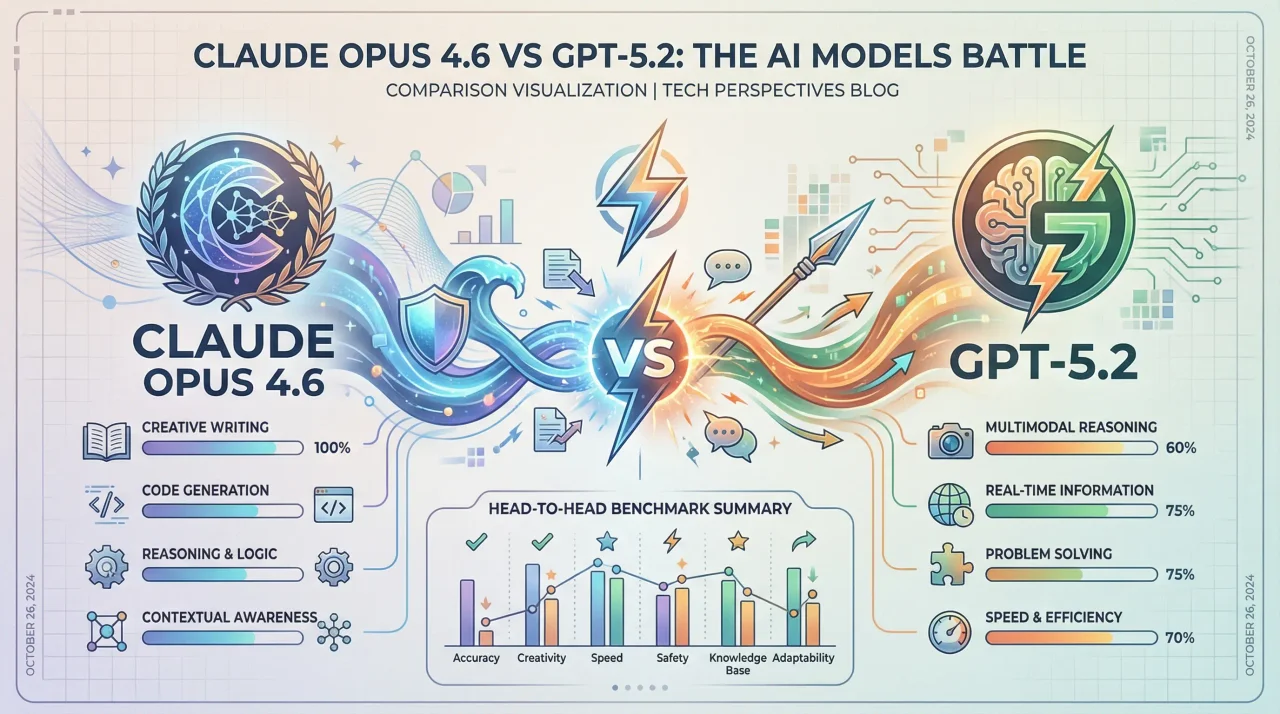
About this article: This piece compares Claude Opus 4.6 and GPT-5.2 to help you choose between them. For a closer look at what changed in Opus 4.6 on its own, see Claude Opus 4.6: What’s New and How It Compares.
Anthropic released Claude Opus 4.6 on February 5, 2026, and OpenAI’s GPT-5.2 had arrived in December 2025. For several months they were the flagship models most teams compared for coding, agents and professional knowledge work. Both have since been succeeded, OpenAI now recommends GPT-6 Astra and Anthropic has released newer Claude models, but many applications still run on these two, and the comparison shows which differences tend to matter. This guide uses the companies’ own published specifications and claims, labels vendor numbers as such, and ends with practical guidance.
Specifications at a glance
| Claude Opus 4.6 | GPT-5.2 | |
|---|---|---|
| Release | February 5, 2026 | December 11, 2025 (snapshot gpt-5.2-2025-12-11) |
| Context window | 1M tokens in beta on the Claude Developer Platform; 200K standard | 400,000 tokens |
| Maximum output | See Anthropic documentation | 128,000 tokens |
| Reasoning controls | Adaptive thinking; effort levels low, medium, high (default), max | Reasoning effort: none (default), low, medium, high, xhigh |
| API price (per million tokens) | $5 input / $25 output; $10 / $37.50 for prompts over 200K tokens | $1.75 input ($0.175 cached) / $14 output |
| Input types | Text and images | Text and images |
Sources: Anthropic’s Opus 4.6 announcement and OpenAI’s GPT-5.2 model documentation. GPT-5.2’s documented knowledge cutoff is August 31, 2025.
Benchmark claims
Anthropic’s announcement compares Opus 4.6 directly with GPT-5.2:
- GDPval-AA, a measure of economically valuable knowledge work in fields such as finance and law: Anthropic says Opus 4.6 outperforms GPT-5.2 by around 144 Elo points, which it translates as scoring higher roughly 70% of the time.
- Terminal-Bench 2.0 (agentic coding): Anthropic reports the highest score among frontier models.
- Humanity’s Last Exam (multidisciplinary reasoning): Anthropic says Opus 4.6 leads all other frontier models.
- BrowseComp (finding hard-to-locate information online): Anthropic says Opus 4.6 performs better than any other model.
- SWE-bench Verified: Opus 4.6 averaged 80.8%.
- MRCR v2, 8-needle at 1M tokens (long-context retrieval): 76%, versus 18.5% for Claude Sonnet 4.5.
These are Anthropic’s results under its own test conditions. OpenAI publishes its own benchmark results for GPT-5.2, and independent leaderboards such as LMArena rank models on different criteria. Small differences on any single benchmark rarely decide real-world performance; test on your own tasks.
Context windows in practice
Opus 4.6’s 1M-token window, available in beta on Anthropic’s developer platform, is Anthropic’s first for an Opus-class model, and the MRCR result suggests it retrieves information across long inputs much better than its predecessors. Prompts over 200K tokens are billed at a premium.
GPT-5.2’s 400,000-token window is large enough for most document analysis and many codebases. The practical question is whether your workload regularly exceeds a few hundred thousand tokens. If it does, such as whole monorepos or large document collections, Opus 4.6’s longer window may matter; if not, other factors will dominate.
Reasoning and effort controls
Both models let developers trade intelligence against speed and cost.
Claude Opus 4.6 introduced adaptive thinking, where the model decides when extended thinking is useful, plus four effort levels. Anthropic suggests lowering effort from the default high to medium if the model overthinks simple tasks. It also added context compaction in beta, which summarises older context so long-running agents avoid hitting limits.
GPT-5.2 exposes a reasoning effort parameter from none to xhigh, with none as the default. That makes it fast and cheap for simple requests by default, with deeper reasoning available when requested.
Agent features
Anthropic introduced agent teams in Claude Code as a research preview with Opus 4.6, letting several agents work on a task together. GPT-5.2 supports a wide set of tools through OpenAI’s Responses API, including function calling, web search, file search, code interpreter, a hosted shell, patch application, skills and MCP, which developers can combine into agent workflows. Both are capable foundations for agents; the choice often depends on which surrounding tools a team already uses, such as Claude Code or OpenAI’s Codex.
Cost comparison
At list prices, GPT-5.2 is considerably cheaper per token: $1.75 versus $5 per million input tokens, and $14 versus $25 per million output tokens. For a workload of 10 million input and 2 million output tokens, that is about $45.50 on GPT-5.2 versus $100 on Opus 4.6 (below 200K tokens per prompt).
Per-token price is not the whole story. Total cost depends on how many tokens each model uses to complete a task, how often it needs retries, and how much human review its output needs. A more expensive model that finishes tasks correctly the first time can cost less overall.
Which to choose
| Workload | Leaning | Why |
|---|---|---|
| Very long documents or large codebases in one prompt | Opus 4.6 | 1M-token beta window and strong long-context retrieval |
| Professional knowledge work (finance, legal analysis) | Opus 4.6, per Anthropic’s GDPval-AA claim | Test on your own documents |
| High-volume tasks where cost matters | GPT-5.2 | Lower per-token price; reasoning off by default |
| Agentic coding in Claude Code | Opus 4.6 | Native integration, agent teams |
| Teams built on OpenAI’s tooling | GPT-5.2 | Broad Responses API tool support |
Migration note
If you are starting a new project, consider the successors. OpenAI’s documentation describes GPT-5.2 as its previous flagship and recommends GPT-6 Astra; we cover Astra’s safety and benchmark picture separately. Anthropic’s newer models continue the Opus line’s focus on coding and agents. Pin model versions in production and re-test before switching, since behaviour and token usage change between versions.
For a broader comparison of the consumer assistants built on these models, see our guide to ChatGPT vs Claude vs Gemini.
Our analysis
Claude Opus 4.6 and GPT-5.2 represent two different trade-offs. Opus 4.6 emphasised long context, careful agentic work and knowledge-work quality at a higher price, while GPT-5.2 offered strong general capability at a substantially lower per-token cost with flexible reasoning settings. Vendor benchmarks favour each company’s own model in different places, so the decision should rest on context needs, budget, existing tooling and a direct test on representative tasks.