AI in Education: How Personalized Learning Is Finally Becoming Reality in 2026
What the evidence says about AI in schools: RAND finds over half of students and core teachers used AI in 2025, and a PNAS trial shows unrestricted chatbots can harm learning while guarded AI tutors help.
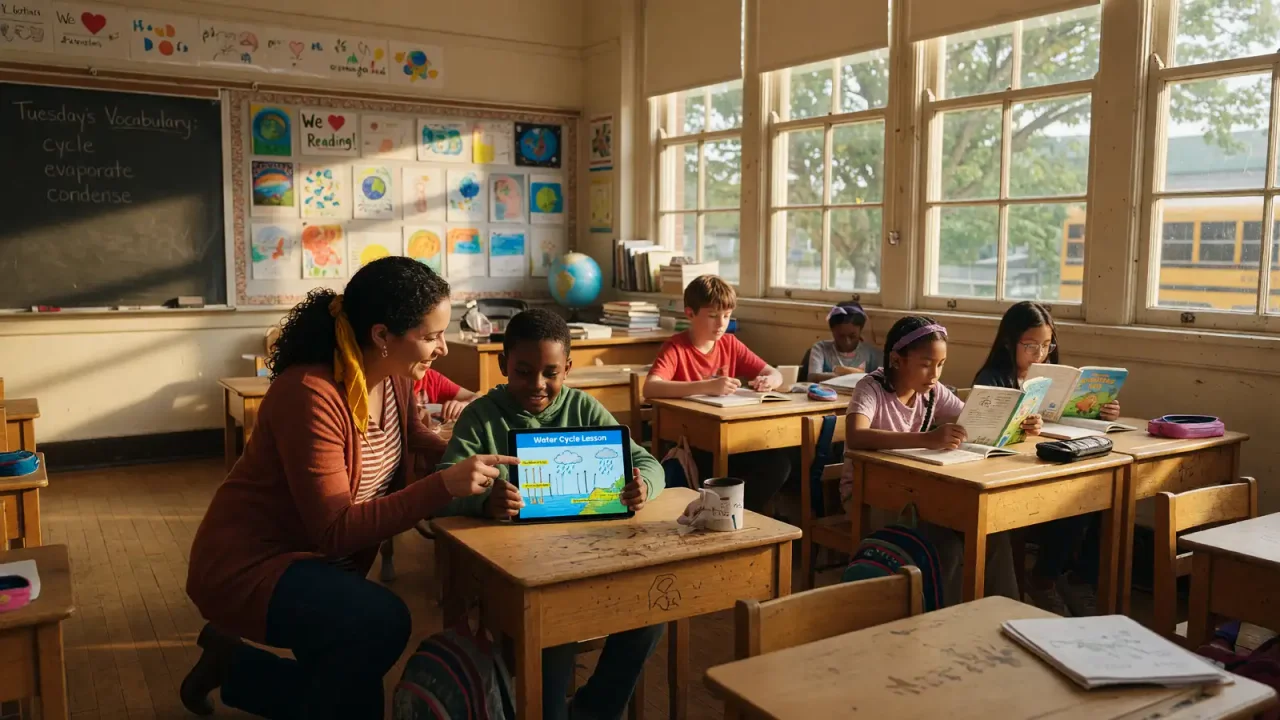
AI tutors and writing assistants have spread through schools faster than most policies could keep up. The promise is personalized learning at scale: every student with a patient tutor that adapts to their level. The evidence so far supports a more careful conclusion. Well-designed AI tools can help, but students given unrestricted access to a general chatbot may learn less, and training for students and teachers lags far behind actual use.
This guide reviews the most useful recent research and survey data, explains what separates helpful AI tutoring from harmful shortcuts, and offers practical guidance for schools.
How fast use is growing
The clearest picture of adoption in U.S. schools comes from RAND’s survey panels. In AI Use in Schools Is Quickly Increasing but Guidance Lags Behind, RAND reports that in 2025:
- 54% of students and 53% of English language arts, math, and science teachers said they used AI for school.
- These are increases of more than 15 percentage points compared with surveys one to two years earlier.
- More high school students than middle school students reported using AI, and use rose with grade level among teachers.
The same report shows concern and preparation lagging behind:
| Group | Agreed that greater AI use will harm students’ critical-thinking skills |
|---|---|
| Parents | 61% |
| High school students | 55% |
| Middle school students | 48% |
| District leaders | 22% |
As of spring 2025, only 35% of district leaders reported providing students with training on AI, and more than 80% of students said teachers had not explicitly taught them how to use AI for schoolwork.
The gap between families’ concerns and district leaders’ views is notable. It suggests that many schools are making decisions about AI without fully reflecting what parents and students worry about.
Students are already using AI for schoolwork
Whatever schools decide, students are adopting AI on their own. A Pew Research Center survey of U.S. teens ages 13 to 17, published in January 2025, found that 26% had used ChatGPT for schoolwork, up from 13% in 2023. Most teens (73%) had not. Use varied by group: Black and Hispanic teens (31% each) were more likely than White teens (22%) to report using ChatGPT for schoolwork, and students in 11th and 12th grade (31%) more likely than seventh and eighth graders (20%).
These figures suggest that a ban-only approach will be hard to enforce and that schools need clear rules about when AI use is acceptable. They also mean assessment design matters: assignments that can be completed entirely by a chatbot measure little about what a student has learned.
What government guidance recommends
England’s Department for Education publishes guidance on generative AI in education, most recently updated in August 2025. Several of its points apply well beyond England:
- Output quality. AI-generated content could be inaccurate, inappropriate or unsafe, biased, taken out of context, taken without permission, out of date, or low quality, partly because tools return results from training data that may not match the curriculum.
- Personal data. The guidance recommends that personal data is not used in generative AI tools. Where it is strictly necessary, schools must take all steps to protect it and make sure pupils and parents understand how their data is processed.
- Homework and unsupervised work. Schools may wish to review homework policies and other unsupervised study to account for generative AI, including guidance on when AI use is acceptable for staff and students.
- Security. Generative AI could make cyber attacks on schools more sophisticated and credible.
The guidance points schools to separate resources on exam malpractice, including what counts as AI misuse in assessed work. Together with the Pew data, it supports a practical approach: set expectations by assignment, redesign tasks that a chatbot can complete on its own, keep personal data out of general AI tools, and teach students how to check AI output.
What the research says about learning
The most informative study to date is a randomized trial published in PNAS: Generative AI without guardrails can harm learning: Evidence from high school mathematics, by Hamsa Bastani and colleagues. Nearly 1,000 high school math students in Turkey were assigned to one of three groups during practice sessions:
| Group | Practice performance | Later exam without AI |
|---|---|---|
| Standard resources (control) | Baseline | Baseline |
| ”GPT Base” (a standard chatbot interface) | 48% better than control | 17% worse than control |
| ”GPT Tutor” (prompts designed to safeguard learning) | 127% better than control | Negative effect largely eliminated |
The result is striking. Students with an unrestricted chatbot did much better while practicing, but performed worse than the control group once the AI was removed. The researchers’ explanation is that many students used the chatbot as a crutch, copying answers instead of working through problems. The tutoring version, which included hints and guardrails designed to avoid simply giving answers, kept most of the practice benefit without the later harm.
For schools, the lesson is that the design of the tool matters more than the presence of AI. Practice scores alone can be misleading; what counts is what students can do on their own afterwards.
What good AI tutoring looks like
Drawing on the PNAS findings and on guidance from education agencies, effective AI learning tools tend to share several features:
- Socratic prompting. They ask guiding questions and give hints rather than full solutions.
- Alignment with the curriculum. They work from the material students are actually studying.
- Visibility for teachers. Teachers can see how students used the tool and where they struggled.
- Limits on answer-giving. They avoid producing complete answers to assigned problems.
- Assessment without AI. Learning is checked in settings where AI is not available.
Several education platforms now market tutors built on these principles. Schools evaluating them should ask for evidence from independent studies, not only usage figures.
The teacher’s role
Teachers use AI for planning lessons, creating differentiated materials, drafting feedback, and administrative writing. These uses can save time, but they work best when teachers review and adapt the output. The U.S. Department of Education’s report Artificial Intelligence and the Future of Teaching and Learning recommends keeping “humans in the loop,” with educators making the final decisions about instruction and assessment.
The RAND finding that most students have never been explicitly taught how to use AI points to an obvious gap. Teaching students when AI is helpful (explaining a concept another way, checking their reasoning) and when it undermines learning (doing the assignment for them) may be as important as choosing the right tools.
Equity and privacy
AI tools could widen or narrow existing gaps. Students with good devices, home internet, and adults who can guide their use are likely to benefit most from general-purpose tools. Students without those supports may rely on AI in less productive ways or not have access at all. Schools that provide vetted tools and explicit instruction help level that field.
Privacy is a second concern. Student data is sensitive and protected by law in many countries. UNESCO’s guidance on generative AI in education and research calls on governments to regulate generative AI tools in education, protect data privacy, and consider age limits for independent use. Schools should check what data a tool collects, where it is stored, and whether it is used to train models.
Practical guidance for schools
- Write a clear policy. Define when AI may be used for assignments, how its use should be disclosed, and what counts as misuse.
- Teach AI use explicitly. Include short lessons on using AI to learn rather than to avoid learning.
- Prefer tutors with guardrails. Choose tools designed to give hints and questions, not complete answers.
- Assess without AI. Keep in-class or supervised assessments to measure what students can do on their own.
- Involve parents and students. RAND’s data shows they are more worried than district leaders; their input improves policy.
- Review data practices. Approve tools only after checking privacy terms and data retention.
- Train teachers. Give staff time to learn the tools and share practices that work.
Bottom line
AI use in schools is rising quickly, with more than half of students and core-subject teachers using it in 2025, according to RAND. The best experimental evidence shows that an unrestricted chatbot can raise practice scores while lowering real learning, and that tutors designed with guardrails avoid most of that harm. Schools get the most from AI when they choose tools carefully, teach students how to use them, and keep assessing learning without AI.
Sources
- RAND, “AI Use in Schools Is Quickly Increasing but Guidance Lags Behind” (RRA4180-1): https://www.rand.org/pubs/research_reports/RRA4180-1.html
- Bastani et al., “Generative AI without guardrails can harm learning,” PNAS (2025): https://www.pnas.org/doi/10.1073/pnas.2422633122
- U.S. Department of Education, “Artificial Intelligence and the Future of Teaching and Learning”: https://www.ed.gov/sites/ed/files/documents/ai-report/ai-report.pdf
- UNESCO, “Guidance for generative AI in education and research”: https://www.unesco.org/en/articles/guidance-generative-ai-education-and-research