AI in Agriculture: How Precision Farming Is Feeding the World More Efficiently
Where AI and precision agriculture deliver documented results: USDA adoption data, See & Spray's reported 59% herbicide savings on 1M+ acres, and a framework for deciding which tools pay off on farms of different sizes.
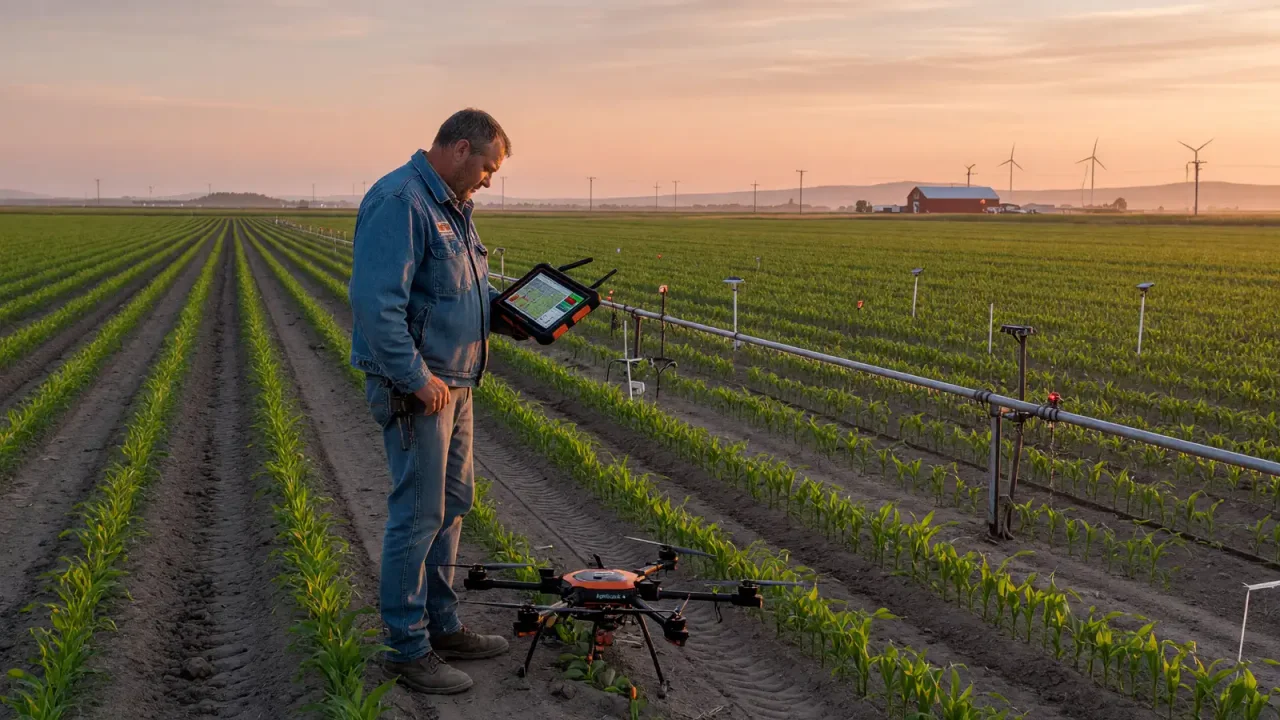
Artificial intelligence in agriculture is often described in sweeping terms: autonomous tractors, satellite-guided farms, and machine-learning models that feed the world. The evidence on the ground is more specific and more useful. Some AI-based tools, especially targeted spraying and guidance systems, now have measurable results across millions of acres. Others remain promising but expensive, and adoption is heavily concentrated on large farms.
This guide looks at where AI and precision agriculture deliver documented results, what the adoption data shows, and how farmers and agribusinesses can decide which tools are worth the investment.
What “precision agriculture” covers
Precision agriculture is the use of data and automation to manage fields at a finer scale than whole-field averages. The USDA Economic Research Service (ERS) groups the core technologies into four categories in its report Precision Agriculture in the Digital Era: Recent Adoption on U.S. Farms:
| Technology | What it does |
|---|---|
| Yield monitors and yield maps | Measure grain flow and moisture during harvest and map yield variation across a field |
| Soil maps | Record variation in soil properties from sampling |
| Variable-rate technology (VRT) | Adjust seed, fertilizer, or chemical rates within a field |
| Auto-steer and guidance systems | Use satellite positioning to steer equipment and reduce skips and overlaps |
AI enters this picture mainly through computer vision (recognizing weeds, disease, or crop stress in images) and through models that turn field data into recommendations. Most farms that use AI today use it on top of these established technologies rather than instead of them.
Adoption: high on large farms, low on small ones
The ERS data shows how unevenly these tools have spread. According to the report summary:
- Auto-steer and guidance systems were used on 5.3% of planted corn acres in 2001 and 58% in 2016.
- Estimates for 2019 put adoption at 72.9% of sorghum acres and 64.5% of cotton acres.
- In 2019, GPS applications were used on 40% of all U.S. farm and ranchland acreage.
- At least half of relatively large row-crop farms rely on yield maps, soil maps, VRT, or guidance systems, while (except for cotton) less than 25% of the smallest farms use any of these four technologies.
ERS suggests the size gap may reflect scale benefits: the returns to adopting a technology can be greater on larger farms, where fixed costs are spread over more acres. That point matters for AI tools too. A system that saves a few dollars per acre is transformative on 5,000 acres and marginal on 50.
ERS also notes that VRT adoption has grown far more slowly than guidance. In the agency’s webinar on the report, the most recent data showed VRT on between 14% of sorghum acres (2019) and 37% of corn acres (2016). Guidance is easy to use and pays back quickly; VRT depends on good soil data and agronomic judgment, which slows adoption.
Targeted spraying: the clearest AI result so far
The most concrete large-scale evidence for AI in the field comes from computer-vision spraying. John Deere’s See & Spray, introduced in 2021, uses boom-mounted cameras that scan more than 2,100 square feet of crop per second at up to 15 mph. Onboard processors decide whether each plant is crop or weed and trigger individual nozzles only where weeds are detected.
Deere reported for the 2024 season that See & Spray was used on more than 1 million acres and saved an estimated 8 million gallons of herbicide mix, an average herbicide saving of 59% compared with broadcast application on corn, soybean, and cotton fields. The same release cited an Iowa State University study that found an average of 76% product savings across its test fields and an economic saving of $15.7 per acre.
Two details from the release help explain the numbers:
- Savings depend on weed pressure. One Minnesota farmer quoted by Deere sprayed postemergence herbicide on only 11% of corn acres and about 20% of soybean acres. Fields with heavy weed pressure will see smaller savings, because more of the field needs treatment.
- Pricing is per acre. Customers pay only for acres where the technology is used, and Deere announced an Application Savings Guarantee for 2025 so customers pay only when there is a saving in application.
The figures come from the manufacturer and a university trial, not from a nationwide independent audit, so they are best read as strong evidence for this specific application rather than as a general measure of “AI in agriculture.”
Crop diagnostics and advisory apps
For smallholders, the most accessible AI tools are smartphone apps that identify crop diseases or pests from a photo and suggest treatment. Apps such as Plantix brought this model to farmers who have no regular access to an agronomist. Their value depends on three things that are easy to overlook:
- Local accuracy. A model trained mostly on one region’s crops and diseases may misidentify problems elsewhere.
- Actionable advice. A diagnosis only helps if the recommended treatment is available and affordable locally.
- Connectivity and language. Offline support and local languages determine whether farmers can actually use the tool.
The general pattern in agricultural research is that simple advisory tools often deliver more benefit to small farms than expensive sensor networks do, because they require little upfront investment.
Autonomous machinery
Autonomous tractors have moved from prototypes to commercial products, and they address a real problem: labor shortages during short planting and harvest windows. They also carry high upfront costs and depend on reliable connectivity and remote supervision. For most farms, the near-term path is likely to be partial autonomy (auto-steer, automated implement control) or paying per acre for services rather than buying fully autonomous machines. The rapid spread of guidance systems in the ERS data shows that farmers adopt automation quickly when it is easy to use and the payback is clear.
Yield prediction and supply chains
AI models that combine satellite imagery, weather, and soil data are increasingly used to forecast yields before harvest, for buyers, insurers, and government food-security monitoring. Their accuracy varies by crop, region, and how far ahead the forecast is made, so published accuracy claims should always be checked for those conditions. For an individual farm, yield maps from its own combine (already used widely on large farms, according to ERS) are usually a better starting point than regional forecasts.
Who owns farm data?
Precision tools generate detailed records of yields, inputs, and field conditions, and that data is valuable to equipment makers, input suppliers, and lenders as well as to farmers. Before signing up for a platform, farmers should check what the contract says about ownership, sharing, and deletion. Ag Data Transparent, an industry initiative, certifies companies that complete its 11-question data-use review based on the Privacy and Security Principles for Farm Data established in 2014. Its published company evaluations summarize how each certified company answers that review. Certification is voluntary and does not replace reading the contract, but it makes comparison easier.
Deciding what to adopt
The adoption data and the spraying results suggest a practical decision framework:
| Question | Why it matters |
|---|---|
| How many acres will the tool cover? | Per-acre savings scale with size; small farms may not recover fixed costs |
| Is the saving measurable on your farm? | Herbicide gallons, fuel, or labor hours are easy to track; vague “efficiency” claims are not |
| What is the pricing model? | Per-acre or subscription pricing lowers risk compared with buying equipment outright |
| Does it depend on data you do not have? | VRT and prescription maps need good soil and yield data first |
| Who supports it locally? | Dealers and agronomists who can calibrate and troubleshoot are often decisive |
A sensible sequence for many row-crop farms is guidance first (fast payback), then yield mapping (builds the data), then targeted spraying or VRT where weed pressure or field variability is high.
The adoption gap is the main challenge
The ERS finding that fewer than a quarter of the smallest farms use any core precision technology is the most important number in this article. The farmers most exposed to climate and price shocks are often the ones least able to invest in new tools. Business models that reduce upfront costs (per-acre pricing, equipment sharing, custom application services, and low-cost phone apps) matter as much as the technology itself.
Bottom line
AI in agriculture is past the hype stage in a few specific areas. Computer-vision spraying has shown herbicide savings of around 59% on more than a million acres, according to Deere, and guidance systems now steer most U.S. corn acreage. The benefits, however, are concentrated on large farms. For most operations, the best investments are tools with measurable per-acre savings and flexible pricing, adopted in a sequence that builds the data more advanced tools need.
Sources
- USDA ERS, Precision Agriculture in the Digital Era: Recent Adoption on U.S. Farms (EIB-248): https://www.ers.usda.gov/publications/105893
- USDA ERS, EIB-248 summary (PDF): https://ers.usda.gov/sites/default/files/_laserfiche/publications/105894/EIB-248_Summary.pdf
- CropLife, “See & Spray customers see 59% average herbicide savings in 2024”: https://www.croplife.com/iron/see-spray-customers-see-59-average-herbicide-savings-in-2024/
- Liakos et al., “Machine Learning in Agriculture: A Review,” Sensors (2018): https://www.mdpi.com/1424-8220/18/8/2674